
DELI DEATH 2
Jack’s Deli in University Heights, Ohio, suddenly shut down on Sunday. There’s no Jewish deli in Cleveland now, although there might be an ersatz deli, sans old Jews, somewhere in Greater Cleveland.
I had a connection to Jack’s Deli. In 1981 I wrote a thank-you note which was posted in the entrance of Jack’s. My letter was about the terrific tray Jack’s had prepared for the bris of my first child, Teddy.
And I’m good with deli-talk banter. Alan Douglass (Yiddishe Cup’s keyboardist) and I often play “16 Tons (of hard salami),” which is a Mickey Katz parody of Tennessee Ernie Ford’s “16 Tons.” After the song, I query the crowd — typically at a nursing home — about their favorite Cleveland delis: Seiger’s, Budin’s, Solomon’s, C&Ls, Irv’s, Lefton’s.
None of which exist now.
I don’t eat much salami or halvah. Maybe that’s part of the reason delis are gone. I used to eat a ton of salami. In high school I sold salamis for a Jewish boys’ club fundraiser. We used the money to go to Washington.
Irwin Weinberger, formerly of Yiddishe Cup, went to Jack’s Deli whenever he visited Cleveland. (He moved to North Carolina four years ago.) Irwin liked the big sandwiches — pastrami or corned beef — and matzo ball soup. And french fries. I never understood the fries, Irwin.
The owner of Jack’s said he hopes to remodel and reopen. He told Cleveland Scene, “I’m not saying that it is going to be a completely different restaurant, but it definitely won’t be called Jack’s and it will make sense for us. We’re going to need some time to put all that together.”
Maybe he’ll call it Mack’s . . .

And don’t forget, Corky & Lenny’s — Cleveland’s other big-player deli — closed in 2023. They had hoped to reopen, too. Deli Death 1.
May 20, 2026 1 Comment
YIKHES
There were several klezmer dynasties in Eastern Euorpe. In America, too. Even in the late-20th century, some baby-boomer klezmer musicians brandished serious yikhes (prominent lineage). Hankus Netsky’s uncle was a klez big shot in Philly, and Henry Sapoznik’s father, who was a cantor, worked in the Catskills alongside clarinetist Dave Tarras.
In Cleveland, the klez-band scene in the past 70 years has been Seaman, then Selker, then Stratton. (There are a lot of S’s in the yiddishe velt. My shul’s yahrzeit list doesn’t hit stride until the S’s. And the Z’s are zippy: Zweig, Zwerdling, Zwick.) My former rabbi used to mix “Stratton” up with “Seaman,” as in “Morrey Seaman” — a 1940-60s bandleader.
My great uncle Earl Kassoff led the Earl Castle Band. This was in the 1930s and 1940s. He was a drummer, xylophonist and house painter.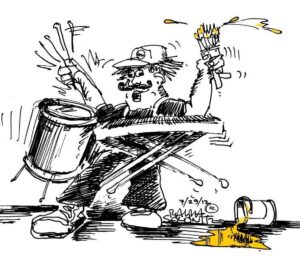
Morrey Seaman owned a dry-cleaning business. I, in case you don’t know, am in the real estate biz. Bandleader Greg Selker went into the executive-search business. Selker founded the Kleveland Klezmorim in 1983 and folded the group in 1990. The Kleveland Klezmorim wouldn’t play “Hava Nagila”; Yiddishe Cup would, so we got all the simcha work.
In 1992 I interviewed a local klezmer musician, Harold Finger. I can’t remember what his day-job was. He described his clarinet playing as “faking”(improvising). When I met him, he was in a community orchestra. “I don’t do much jobbing anymore,” he said. (“Jobbing” was gigging.) Harold died several years after the interview.
I thought Harold’s kids would want a copy of the interview tape. I called a son and left a message, and didn’t hear back. The son should have called me. Harold’s wife was on the tape, too, badgering him about how he loved his axe more than her. Harold said, “What? I quit playing music for you!”
Coda: Another macher on the Cleveland Jewish music scene in recent decades was bandleader Barry Cik (pronounced “chick“). He had yikhes to-the-nth-degree. He’s from a family of Hungarian Jewish musicians. In the 1990s Cik’s son Yehuda was quite prominent on the national Orthodox Jewish music scene, and Barry wouldn’t shut up about it. When I played with Barry’s band as a sideman, I thought to myself What about your own band, Barry? The one I’m playing with right now! But Barry preferred to talk about his son’s band.
I get that now.
Yikhes (pronounced YIH-khiss).
May 13, 2026 1 Comment
A RED FLAG
Sharon, a jazz saxophone teacher, pitched me a year-long package of music lessons. I don’t have “big ears” — as the jazzers says — and I want to improve my ear-training and chord-recognition game.
I was on a Zoom call with Sharon, who was based in Los Angeles. She wanted to talk about my motivation, and I wanted to talk about cost of the lessons. She didn’t want to talk about money. She had a PAC system and an HSP system — these initials stood for something. I don’t know what. She asked what my level of motivation was, on a scale of 1-to-10. She wasn’t happy when I answered “5.”
I said, “What if I’m in a group lesson on Zoom with beginner musicians who don’t know what a C7 chord is? Maybe I should I do a solo course.” I had found Sharon on the internet. (She said to tell you the truth a lot, which annoyed me.)
An hour later she told me the solo course was $1,200, for a year. Sharon continued, “But my assistant, Juliet, in the Philippines, will send you a link to knock it down to $500. And I’m going to be a hardass about that. There will be no access to coaching in the solo course, and the price is good for a week, cool? This isn’t about money, it’s about increasing your motivation.”
Sharon’s bio said she had majored in psychology and music.
Her quick drop from $1,200 to $500 jolted me.
This was a bit of a red flag, no?
I called my son the musico and discussed the matter. He said the whole thing sounded “opaque.” I passed.
[“Sharon” is a pseudonym.]
—
Yiddishe Cup plays a free Mother’s Day concert this Sun., May 10, 2-3 pm. Beachwood library branch/ Cuyahoga County Public Library, 25501 Shaker Blvd [corner of Shaker and Richmond]. Beachwood, Ohio. We’ll play “My Yiddishe Momma,” “Natural Woman,” and klezmer!
May 6, 2026 2 Comments
THE MENSCH
After I received smicha (rabbinic ordination), I interviewed for a few rabbi gigs. This was around 1978. First I interviewed at the Hillel in Norman, Oklahoma, but I couldn’t see myself there. I’m not a geography snob, but Oklahoma was not OK. I didn’t insist on a sexy spot like Encino, Marin, or Bethesda, but how about a place with some Jews?
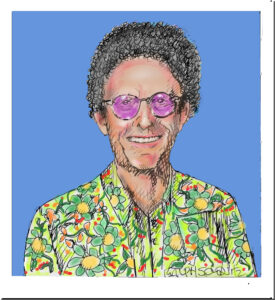
The Mensch, 1978
I took a stab at Omaha. Don’t underestimate the Jewish scene there. The board of trustees at BethSteak grilled me — grilled me hard. Back then I had a Jew-fro and looked like I’d just come off the beach in Venice, California (which wasn’t too far off the mark). A board member asked, “How would you liven up our Purim carnival?”
I’d throw glow sticks all over the social-hall floor, and I’d free the goldfish from the tank. I’d pass out Free The Fish! signs. What I actually said: “I’ll listen. I’m a good listener.”
A trustee asked me how I’d handle lifecycle events.
“I’d show up,” I said. (Lifecycle was a new word back then.)
My responses to the board were all short. I was nervous, facing 20 AKs. At 28, it was difficult to string together wisdom for the elderly. Maybe I should have delivered my hard-hitting sermon “I’ve Got the Jewish Blues,” complete with blues harp accompaniment. Instead, I did a dvar Torah. I don’t remember exactly what I said, but I ended with “The key is listening.” (I picked up some stock lines at rabbinical school.)
A board member asked when I was getting married. I said, “Have you got someone for me?” That got a laugh.
I flung some Hebrew; I knew more Ivrit than they did. They weren’t going to get anybody better than me.
The board president asked the last question: “How would your friends and family describe you?”
Thank you, Mr. President, for that question! I said, “I don’t like to talk about myself, but I suspect my friends and relatives would say, in a word, I’m a mensch.”
Mensch — that’s the password. It unlocks the door to the Holy of Holies and all the other Temple doors, including the pantry. If you’re a mensch, you’re in. I got the gig.
And I turned it down! Me — geo snob. I wasn’t going to Omaha, Nebraska.
I did one final interview, in Muncie, Indiana — even smaller latkes. (The word had gotten out that I had turned down Omaha.) The Muncie rabbi bought all the food for the kiddushes and spread out the hummus and poured the wine.
I didn’t get the Muncie gig. A folksinging rabbi did. I heard her clips years later on YouTube. Not bad.
I wound up in property management in Cleveland. I blame that on my father. He led me into the promised land: the dog-eat-dog world of apartment management. I joined the rabid/ate.
[fiction]
—
Yiddishe Cup plays a free Mother’s Day concert 2-3 pm Sunday (May 10) at the Cuyahoga County Public Library, Beachwood branch, 25501 Shaker Boulevard [corner of Shaker and Richmond], Beachwood, Ohio. Best to register. You can probably get in without registering, but it’s best to sign up.
April 29, 2026 2 Comments
“GET OUT OF HERE!”
THE JUDGE SAID
I got in some trouble. Didn’t we all? Nothing horrible. Look, I studied hard and turned in my homework on time.
And I wound up in South Euclid court twice. I was riding around on a motorcycle without a helmet. I was on the back of the cycle; a roommate from my A2 dorm had come down to Cleveland and wanted to ride around. Riding without a helmet was against the law. The South Euclid judge knew me; I was a friend of his older son — the valedictorian of my class. The son and I had been in the same JCC boys’ club.
The judge’s son once drove the wrong way on Belvoir Boulevard. He didn’t realize he was driving on the wrong side of the grassy median strip. Nobody died, and nobody was arrested.
 The South Euclid judge, by the way, had a quality collection of high-fidelity sound effects LPs, and a good turntable and speakers. I occasionally went over to his house after school and produced audio stories, along with his son, using sound effects.
The judge threw out my case regarding the “no helmet.”
The judge had a younger son, who went to Annapolis, which was a odd for a Jewish boy, but not that odd. That son eventually wound up as the acting chief of the Cleveland FBI and gave me a tour.
Another high school friend, Jerry, joined the Marines, and right before he went in, he had the idea that we sneak into the Mayfield Country Club (strictly off limits for non-members). We jumped into the swimming pool in our underwear and then stole the golf course’s 18th-hole flag.
The fuzz nailed us on the way out of the club.
We wound up at the South Euclid jail in our underpants. (White.) Again, the judge threw out my case. He said, “I’m not going to see you in here on a regular basis, am I?”
“No, sir, you are not,” I said.
“Get out of here!”
—
(The first half of this story is true; the second half is fiction.)
April 22, 2026 2 Comments
HORSESHOE LAKE —
THE CONTROVERSY THAT WILL NOT DIE
[This essay, in abbreviated form, was in the Cleveland Plain Dealer on Sunday.]
In 2019 I walked over to Horseshoe Lake – which straddles Shaker Heights and Cleveland Heights — to see a bit of nature. The lake was gone. It was missing. The Northeast Ohio Regional Sewer District had drained it.
And NEORSD hasn’t refilled it.
I’ve seen “missing dog” signs on neighborhood phone poles, but I’ve never seen a “missing lake” sign. Maybe I should put one up! Our family’s dog went missing last week. She ran away. And then she was found. Unlike my lake.
Horseshoe Lake (and adjacent Lower Shaker Lake) are like Central Park for many East Side residents. The lakes are refuges — our lungs. The lakes are a blue space. Residents from throughout Cleveland come to Shaker Lakes for fresh air and to clear their heads. We hike, meditate, see birds, see blue water, and talk to neighbors who are walking dogs.
At the latest Cleveland Heights city council meeting, approximately 80 citizens showed up to protest NEORSD’s removal of Horseshoe Lake and the sewer district’s proposed gutting of Lower Shaker Lake. Twenty residents spoke. Each had two minutes. What particularly ticked off many of the speakers was NEORSD’s plan to chain-saw about a thousand trees, and plant saplings, plus add riprap (small rocks). The end result will be “re-meandered” streams where Horseshoe Lake was.
This was news to many locals. Shaker Lakes news does not bump off Trump/Iran-level headlines. For instance, Paul Springstubb, a Cleveland Heights resident, didn’t realize what’s in store for Shaker Lakes. He does now. He just texted me, “Just read about the packed Cleveland Heights council meeting. I can’t believe residents of Shaker and Cleveland Heights won’t vigorously work to stop a clear-cut of the lakes’ trees! What I’ve begun to fear is the natural feel of a lake — with its surrounding mature trees – turns into a totally over-planned, neatly groomed, ‘just so’ park.”
Springstubb, who is a retired Shaker Heights High English teacher, continued: “All these saplings that the NEORSD plans to plant. That’s not nature. That’s upscale mall/commercial planning, like Legacy Village, Lyndhurst. Maybe we’ll have loudspeakers in the scattered ‘rocks’ located along the redirected, but perfectly serpentine, streams. Maybe the speakers will play songs of the various birds that lost their homes at Horseshoe Lake.”
NEORSD and saplings. Spare us the sunburn due to the lack of shade for the next 10 or 20 years while the saplings mature.
If any Shaker Heights or Cleveland Heights elected officials acquiesce to the destruction of Horseshoe Lake and Lower Shaker Lake, their names should be registered in the imaginary Albert Porter Hall of Shame. (Porter was a county engineer who tried to run a freeway through the Shaker Lakes in the 1960s and was stopped by citizens civic groups.)
Cleveland Heights’ new mayor, Jim Petras, said at the council meeting that the City/ NEORSD deal to eliminate Horseshoe Lake was made before his time. That’s not a good excuse, Mr. Mayor. The cities of Shaker Heights and Cleveland Heights can rectify this monumental screw up.
In the public-discussion portion of the council meeting, Cleveland Heights resident Kevin Charnas nailed the situation in one sentence: “The sewer district just bulldozes stuff, pun intended.”
Erin Flanagan, a Cleveland Heights lawyer, has filed a federal suit to slow down the sewer people. Amy Weinfurtner of Shaker Heights has led citizen opposition to the lakes’ destruction. She
If Horseshoe Lake or Lower Shaker Lake go away, they’re not coming back. Dogs come back. Lakes don’t.

Horseshoe Lake when it was a lake.
April 15, 2026 No Comments
BOOMER BOULEVARD:
LEE ROAD, CLEVELAND HEIGHTS
I’ve spent many hours on Lee Road, and I’m going to spend another hour and half there on Saturday, May 2, when the Klezmer Guy Trio performs at Heights Arts, 2175 Lee Road. We’ll play klezmer, Motown and swing, interspersed with spoken word.
Here’s a “spoken word” (in writing) . . .
Boomer Boulevard: Lee Road. I attended Fairfax School’s Grandparents Day and told everybody my grandchild was “Jim,” as in Gym. I didn’t have a grandchild back then, in 2012. I watched my wife, Alice, then a phys-ed teacher, lead a class. She wore a mic like Madonna. Alice was not a roll-out-the-ball gym teacher.
After the grandparents’ event, I walked by the Lee Road library and wondered if I should submit an application for the library’s board of trustees. I had already filled out the application but was worried it might have been too flippant, so I hadn’t submitted it. I had used the word “libe.” (Later, I did submit the application and got rejected.)
Classical music blared outside the Subway at Lee and Meadowbrook Boulevard. Must have been a crowd-control thing.
At the Lusty Wrench, Sam Bell, the owner and chief mechanic, told me he drove less than 1,000 miles a year. I asked, “When did you start hating cars?”
Sam said he used to like cars; he said he once drove 160 mph from Baltimore to Chicago in college. Apparently Sam liked the idea of cars, but not actual cars.
Tim Burdick, a woodwind repairman, worked next door to the Lusty Wrench, on the second floor of the Douglas Building. Tim had a $350 mouthpiece lying around. “It’s Frank’s,” Tim said. “Frank” as in “Franklin Cohen” — the then-principal clarinetist of the Cleveland Orchestra. I tried the extra mouthpiece and took it home and ran it by the musicians in Yiddishe Cup. They couldn’t hear any difference between Frank’s mouthpiece and my own. Keyboardist Alan Douglass said I didn’t sound in control with Frank’s mouthpiece.
I planned to meet Carlo Wolff for dinner at Marotta’s. Carlo was a jazz critic who had become a reporter for the Cleveland Jewish News. I wondered how Carlo was fitting in at the paper; he’s Jewish but “not very Jewish,” he told me. At the dinner he reported he was doing fine at the paper.
The epicenter of Lee Road is — you know this — Stone Oven. Yes, I go there; it’s my obligation as a baby boomer. I got in line in back of Ray Lesser, the editor of the Funny Times. Ray had recently turned down some of my funny stories. I didn’t bring that up. I took the high road!
Carl Goldstein — a Cleveland Heights landlord – went to the Stone Oven every morning. I promised I would start hanging out there with him. But I never did. Every morning? I’m just not that social.
The “Lee” in “Lee Road” comes from a farmer named Lee. I learned that fact on a local-history walking tour. Other farmers included Silsby, Taylor, and Dille.
Here’s a bit of immaterial Lee Road music history: the first time I saw a live professional band was at the Stardust Ballroom, which was in back of the Cedar Lee Theatre. I was in junior high, at a bar mitzvah party, and the bandleader was Morrey Seaman. Maybe he was playing “Stardust” at the Stardust.
Have you ever noticed how Cleveland Heights High grads like to reminisce about the Cedar-Lee neighborhood? Even more than I do. That’s their nexus — the Cedar Lee Theatre and what used to be around there: Mawby’s, Meyer Miller shoe store, Earth by April. A Heights High grad, Jimmy Sollisch, once told me he learned almost everything in life by selling shoes at Meyer Miller as a teenager. Meyer Miller’s co-owner was Cuppy Cohen.
There was a pool hall next to the Cedar Lee Theatre: Wally’s. Who cares about Wally’s? Not me. People who grew up in the Heights care about Wally’s. I grew up in South Euclid and don’t care about Wally’s. Let’s talk about Mayfield Road in South Euclid . . . the Cream-O-Freeze, Warehouse Beverage, Alesci’s. (No, different story.)
If you stand on the glass-enclosed Heights Library walkway over Lee Road, you’ll see a fair amount of life pass by. Nothing too monumental–- no gigantic moving vans or rock-star buses, like you might see at the New York Thruway overpass at Angola, New York. But give Lee Road some leeway. It’s got some life.
—
CONCERT INFO:
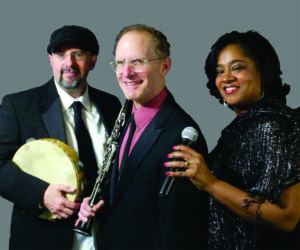
The Klezmer Guy Trio performs 7 p.m Saturday, May 2, at Heights Arts. Admission is free with ticket(s). Tix are available here. Donations are accepted. Seating is limited. The Klezmer Guy Trio is Tamar Gray (vocalist and Fairfax Elementary School music teacher), Alan Douglass (keyboards) and Bert Stratton (clarinet and spoken word). The show is a mix of klezmer, Motown and spoken word. A variety show, sort of.
April 8, 2026 2 Comments
AN ACCENT-LESS SEDER
My last cousin left Cleveland in 2001. My relatives went to warmer places or died. Cleveland was not hopping. (Still isn’t.) I’m in about two traffic jams a year in Cleveland. I would prefer five. I don’t relish the horrible traffic of Chicago or Washington, but just a few more traffic jams in Cleveland would be nice.
I’ve got mishpocha in Chicago, and that’s where I’ll be for Seder tonight My daughter and family live in Chi, plus my wife also has a slew of first cousins there. They all moved to Chicago decades ago from Clarksburg, West Virginia. Just upped and left Appalachia for pancake-flat Chi. (The West Virginia exodus makes Cleveland’s population-loss look like nothing.)
I remember, in the 1970s Clevelanders first began imagining the whole town could go under. A musician in Milwaukee even wrote a song called “Thank God This Isn’t Cleveland.”
Some Clevelanders never got over the trauma of the 1970s. I know Clevelanders who vacation on Cape Cod because they’re instructed by the national media to vacation on the East Coast. They wait an hour for ice cream on Cape Cod. Why?
Some of the best scenery in America is the bike path from Gambier to Coshocton, Ohio. Rolling farm country, horses, sheep, cows, pigs and Amish buggies.
But some Midwesterners need to see the ocean. They drive all day to the Carolina shore. Hey, Lake Erie has beaches, waves and miniature golf. Check out Geneva on-the-Lake or Put-in-Bay.
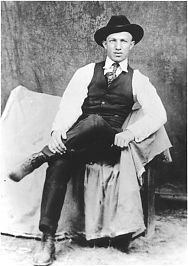
Willie Sklar,1920s. Louise, Miss.
After my relatives bailed, I looked for distant relatives elsewhere. I found them via the media. My son Teddy found a Mississippi connection on a PBS documentary, “Delta Jews,” about the Jews of the Mississippi Delta. The mayor of Louise, Miss., had been my mother’s cousin. (My mother grew up in Yazoo City, Miss.) Teddy called a Mississippi relative who had been in the documentary. We eventually met the Mississippi clan and have gotten together with them several times. Most are lawyers. They have Southern accents. That’s what you want from Southerners — an accent. So often an educated Southerner will disappoint you on that front.
My West-by-Gawd Vuh-gin-yuh relatives don’t have accents. Maybe I can induce them with wine and afikommen money to fake accents tonight.
—
I’m part of a kosher-style, David Sedaris-ripoff reading / music gig 7 pm. Sat., May 2, at Heights Arts, 2175 Lee Road, Cleveland Hts. It’ll be klezmer, spoken word and Motown. The trio is Tamar Gray (vocals), Alan Douglass (keys), and me on clarinet and spoken word. The event is free but get a TICKET prior because the gallery will probably “sell out.”
April 1, 2026 2 Comments
ALL QUIET — THEN NOT QUIET —
ON THE WESTERN FRONT
I had a neighbor who frequently offered me Beck’s beer. I could only drink so much. This guy could drink. His name was Weinberg and he wore a huge cross. (I once met a Jew in New York who wore a cross, too; he said he wore it to keep away the Chabadniks.)
My neighbor — or maybe it was his father — was a heavy-duty convert to Christianity. They all belonged to a Romanian Orthodox Church on the West Side.
 My neighbor was quiet — no dogs, no loud music. Perfect. Just one small negative: he had a big Mercedes box truck (against city code). But I was OK with that.
Also, I didn’t like his snow blowing. It was too loud; I offered to hire a plow for his drive, but he turned me down. A very quiet guy.
Except one night in July 2012 around midnight . . .
I had my earplugs in; nevertheless, I could hear screaming. I thought it was from across the street, where teenage boys sometimes partied late. I tried to sleep through it. But then the cops showed up.
This was right next door. The convert was chasing his wife around with a butcher’s knife, and the couple’s kids were screaming. Four cop cars pulled up. My neighbor, in handcuffs, said through the bushes, “What’s going on, Bert?”
I didn’t know.
The family disbanded shortly after that. The wife said she was going to Phoenix with the kids, and she mentioned the convert had had extramarital affairs, and the kids talked about drunkenness, like “Daddy drove on the sidewalk.”
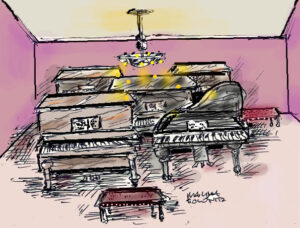 There were four pianos in the living room — three uprights and a baby grand. The convert said he fixed pianos for a living. About a month after the knife-chase, he came back for the pianos, with a police escort. I think he was charged with domestic violence. Maybe there was a restraining order, too.
Then a private detective showed up at my house; he wanted info on Weinberg. I didn’t know much except his preference for Beck’s.

—
Historical-accuracy footnote: The house was on the northern front, not western, but “western” makes for a better title.
—
THE KLEZMER GUY TRIO:
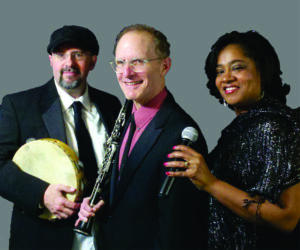
(L) Alan Douglass, Bert Stratton, Tamar Gray
I’m part of a kosher-style, David Sedaris-ripoff reading / music gig 7 pm. Sat., May 2, at Heights Arts, 2175 Lee Road, Cleveland Hts. It’ll be klezmer, spoken word and Motown. The trio is Tamar Gray (vocals), Alan Douglass (keys), and me on clarinet and spoken word. The event is free but get a TICKET prior because the gallery will probably “sell out.”
March 25, 2026 1 Comment
I’M NO LONGER
AN EMBARRASSMENT
TO MY FAMILY!
I have some troubled relatives. One of my siblings thinks I’m his personal ATM. He’s always going in and out of jail. Small stuff, but I have to bail him out. And then there’s my cousin Shelly, who is a doofus; he used to steal my car from my driveway and just drive it around and smash it somewhere. I finally got a video cam on my house.
Next, I wound up in jail. Everybody’s minds were blown; “Bert wound up in jail!” I’m 75 and the last guy you’d expect in jail, right? I mean, you read this blog. My relatives gloated.
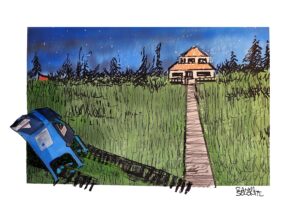 Here’s the story. One night I took a Valium, which I’m wont to do on occasion, and got in my car. I know, “Don’t handle heavy machinery or operate a fork lift.” I wasn’t going to chain-saw any trees. I was driving to Fairmount Circle for some ibuprofen. I smashed into a mailbox.
A United States mailbox costs $5,000. I know, believe me.
The cop made me walk a line, which I couldn’t. He handcuffed me and took me to the Shaker Heights jail. Going into the cell at the police station, I said, “You got any espresso?” I was trying to lighten the mood. No go.
I sat in the cell for six hours — me, a toilet and a sink. Finally my brother — the one who is always hitting me up for money — bailed me out for $176, cash.
Now I’m on a year’s probation. And don’t forget the 5K for the mailbox. And there was another 4K for the lawyer.
Was it worth it? Yes. I’m no longer an embarrassment to my family. I’ve been to jail!
[fiction]
March 17, 2026 No Comments
CONTAGIOUS
I’ve probably been to eviction court 100 times in Lakewood, Ohio. In the old days I actually stood in a real courtroom with a judge with a gavel. But nowadays I meet up in a conference room with a magistrate. The guy knows me. Believe me. We sometimes exchange pleasantries post-hearing. But not usually. The guy is in a hurry. The other day I faced off with a deadbeat tenant — nothing unusual here — except he announced to the magistrate and me, “I probably shouldn’t even be here. I have a contagious disease.”
That got our attention. He said he couldn’t go to work because of the disease. The magistrate shut him down and gave him the eviction notice — the red tag — right then.

The magistrate
Post-adjournment, the tenant explained he was “skin-to-skin contagious.” So you have to touch him to get what he had. That made us all feel better.
—
And please read my essay “Rolling the Dice” in the latest Forum magazine. Author Jim Sollisch says it’s one of my better outings.
March 10, 2026 1 Comment
PANAMA / YOUNGSTOWN / FLORIDA
Yiddishe Cup’s violinist, Steve Greenman, flew back from Panama City, where he recently played a wedding gig. That’s class and must be noted. Steve is one of the world’s top klezmer violinists.
Then a couple nights later, he played — with Yiddishe Cup — a gig in Youngstown, Ohio, a town that gets an end-of-the-world rap. But note, Youngstown has a Classic Reform shul built in 1915. Congregation Ohev Beth Sholom. It’s like a miniature The Temple, Cleveland (now the Maltz Performing Arts Center).
Elyria, Erie, New Castle, Sharon, Warren, Canton, Lorain, Akron. Yiddishe Cup has played them all. Many of these Rust Belt shuls are history.
Youngstown’s Ohev Beth Sholom has about 300 families, down from its peak in 1967 when it had 710 families and 395 kids in the religious school. There are a lot of yahrzeit plaques on the walls there.
At Yiddishe Cup’s Ohev Beth Sholom gig, a former Shaker Heights resident described her move to Youngstown as a “reverse exodus.” She said, “You can get everywhere here in eight minutes. Friendly people, too.” She married a doctor from Youngstown.
Yiddishe Cup’s most successful Y-town gig was more than 30 years ago at Temple El Emeth. The rabbi at El Emeth went on to become the head rabbi at a Boca Raton synagogue, and he brought Yiddishe Cup to Florida twice. Dead of winter both times. Nice.

Congregation Ohev Beth Sholom (formerly Rodef Sholom). Youngstown
March 4, 2026 1 Comment
DISORDER
Alice told me to read a Wall Street Journal article on how everybody is ADHD or a variant on that. I fit a couple of the traits; I don’t like scratchy labels or noise. But then I didn’t fit into the “always late” and “loses things” categories.
I’m on time and don’t lose stuff. I told Alice, “I’ve had the same gloves for years,” In fact, I have three types of gloves: liners, regular gloves and mittens. Baby, it’s cold outside.
I went to a concert and took the mittens and liners. I wore some of that stuff indoors, at the concert, which was in my former temple, where I had grown up. A drafty, big place. The Maltz Performing Arts Center.
The concert was a tribute to Hoagy Carmichael by the Cleveland Jazz Orchestra. Very well done. Alice didn’t want to go. I sat by myself. Ninety minutes later: done. No glove liners. What?
I went up into the balcony, where I had visited some friends during intermission. No gloves liners. I went to the men’s room. No liners. I got home and told my wife I now fit the profile in the WSJ story.
Then I found my glove liners. They were balled up inside my ski cap, which was on my head. In other words, I had been wearing the glove liners on my head.
What’s that disorder called?
—
Yiddishe Cup plays on Purim at Park Synagogue (Pepper Pipes, Ohio) on Monday (March 2). Free. 7:15 pm.
February 25, 2026 1 Comment
I WAS OUT OF MY SKULL
I was out of my skull. I broke into boxcars and unloaded Cutty Sark, golf balls and tires. Sometimes, tennis shoes. I had tin snips that cut right through corrugated boxcars roofs.
This was 50 years ago. Now I live a fairly quiet life. I’d rather not say where.
Let me tell you about my life. I never got married. I should have. There was this gal in the 1970s — Roz. She loved me but I wasn’t ready for her. Schmuck — me! I was 45, for God’s sake.
I was in the Marines. I couldn’t stand it. I was in for six months. Semper Fidelis was plain bullshit to me.
You ever notice how Italians swear all the time? It’s very big with them. If you’re Italian, you’re better than me, and you can cuss all day long. You can be the dumbest dunderhead on two feet, but if you’re Italian, you’re it.
I could be Italian if I wanted to be. I got enough spaghetti and wine in my veins. And don’t forget the goddamn hot peppers. I can eat a whole mason jar full.
Odd fact: I’m Jewish. I grew up in a deli on Kinsman in Cleveland. I remember the pickles. The cukes were right in the goddamn basement. They were delicious. And the goddamn gherkins.
My family disowned me after Marion. What was a nice Jewish boy doing in the joint? Not kosher! I haven’t talked to any relatives in, I bet, 50 years.
When I got out the last time, I made a clean slate of things. I sold stained glass to restaurants. Completely legit. I didn’t like it. So I went back to stealing. The hardest part was carrying the loot. I was that good.
Punchline: I was an accomplice several times but never killed anybody. The chickenshits from Murray Hill did the killings. They didn’t have my abilities. They stood around with their hands in their pockets, except they could kill.
Crime is a head game. Keep your mouth shut and show some intelligence and you’ll be fine. It has worked for me, most of the time. I’m paranoid. Sometimes you just know a place is a death trap.
It’s all trial and error.
My biggest mistake was quitting high school. I thought I knew more than the teachers. Again — schmuck! I hung out with boys who ran a stolen butter and cigarette ring on Woodland. An old fat Jew — The Eggman — was in charge. I rigged him up a walkie-talkie, which he appreciated.
Nowadays? For one thing I don’t have a dime. I spent everything I ever earned. I blew it all on cards, broads, beer and racehorses. It all fell through. I couldn’t deal with the thickheaded Italians at the track. I got out, but too late.
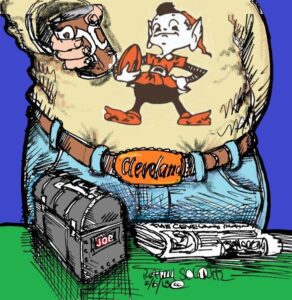 I live on wieners and beer. Love that combo. And the Browns. I remember when I pinched three cases of sausages from Red Barn. I didn’t fence it. I ate it all!
I’m 79 and in male menopause now. The docs talk about that on TV.
I love my TV. It doesn’t talk back to me. Perfect.
For the record, here’s my record:
NAME: JOSEPH A. MOSKOWITZ
ALIAS/NICKNAME: JOEY MOSCOW
DOB: 12-11-46
FACIAL ODDIITES: UNK
FACIAL HAIR: MUSTACHE
SPEECH: POLITE
COMPLEXION: MED
MISSING BODY PARTS: UNK
GENERAL APPEARANCE: UNKEMPT
TEETH: UNK
SCAR/BIRTHMARK/MOLE: UNK
TATTOO: UNK
WT: 245
HGT: 5-8
ADDRESS: UNK
CONVIC: MANSLAUGHTER, AGGRAV BURGLARY, LARCENY, KIDNAPPING, CRIMINAL TOOLS, GRAND LARCENY
February 18, 2026 1 Comment
TWO ANN ARBOR BLUES BOYS
Mark Schilling wrote this guest blog post:
Bert and I first met at Mich House (Michigan Cooperative House) in the fall of 1969. He was then a sophomore and I was a junior at the University of Michigan. We were both natives of Ohio or, as OSU football fans would say, “traitors.” I had lived in Barberton, Ohio, from grades one to eight, Bert in Cleveland from day one, so we shared memories of local TV shows and sports teams.
But our first and, for a while, foremost bond was musical. Bert, who had been a founder of the Ann Arbor Blues Festival, pronounced my record collection “cool,” especially for American Blues Festival, a rare LP of performances by Sonny Boy Williamson, Memphis Slim and other blues artists recorded in Bremen, Germany, in 1963. I’d found it in a cut-out bin in Dayton, Ohio.
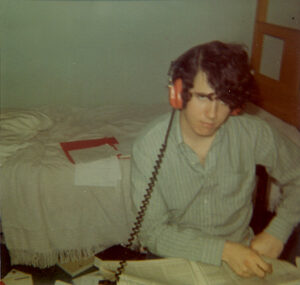
Mark Schilling, 1970, Mich House
We listened to this and other records in Bert’s second-floor room, which he shared with John Cochrane, a laid-back Michigander who kept his hair short due to his service in the National Guard. We soon branched out to jazz, from Louis Armstrong and Duke Ellington to Charlie “Bird” Parker, Dizzy Gillespie and other titans of bop.
A few ancient (i.e., over 30) grad students shared reminiscences about Dave Brubeck and other jazz favorites of their youth when they heard us spinning jazz discs (mostly borrowed from the Ann Arbor Public Library) on the record player in the living room, but other undergrads living or boarding at Mich House were rock fans so we became a Jazz Appreciation Society of two.
John, however, joined Bert and me on an expedition to Baker’s Keyboard Lounge, a jazz club in Detroit still in operation, to hear a “battle of the saxes” between Sonny Stitt and Gene Ammons, who had just finished a seven-year prison sentence for a narcotics possession charge. The place was packed but we were the only white guys in sight, save for the club owner, Clarence Baker, who was at first thrilled to see college kids in his joint, but became peeved when we didn’t order drinks for the second set. (I broke down and got another beer. Not sure about Bert and John.)
The music was great, prompting us to seek out more live jazz (if minus John). We caught a Duke Ellington concert at Hill Auditorium, sneaking down from the cheap seats to empty ones near the stage, as gray-haired audience members shot us looks both amused and surprised.
We also saw Rahsaan Roland Kirk in Detroit, where he played multiple horns simultaneously, blowing many minds, and Miles Davis at Hill Auditorium, where he and his quintet played tunes from his new album Bitches Brew. (Bert, who was sitting with me about 20 rows back, walked up to the stage and asked Miles something as he was preparing to play, which given Miles’ fearsome public image I thought took balls of brass.)
Then writing about music for the Michigan Daily student paper, Bert also caught folkies like Buffy Sainte Marie and Michael Cooney and blues greats like Mississippi Fred McDowell and Big Mama Thornton with me tagging along.
We also went to the John Sinclair Freedom Rally, a 1971 concert for poet/activist John Sinclair, who was then serving a 10-year prison sentence for selling two joints to an undercover agent. John Lennon showed up with a tune he had specially composed for the occasion, together with Yoko Ono, Phil Ochs, Bob Seger, Stevie Wonder, Commander Cody and others. Sinclair was sprung shortly thereafter.
Bert and I also ventured to the Cincinnati Jazz Festival at Riverfront Stadium in July 1971 to catch Billy Eckstine, Chuck Berry, Dizzy Gillespie, Herbie Mann, Lee Morgan, Rahsaan Roland Kirk (again) and Roberta Flack. A group of Black ladies sitting near us swooned over Billy but laughed at Chuck. His duck walk wasn’t their thing.
Along with all this concert- and club-going, Bert was playing the harmonica and the sax – the later to the annoyance of the guy across the hall, a music grad student from Texas who had the only single room in the co-op, which he wasn’t about to give up because of Bert. And Bert wasn’t about to stop playing in his room since he had nowhere else to practice. So the grad student, Morris, and Bert would exchange words while John buried his head in the blankets of his upper bunk bed, and I studied cracks on the wall.
Morris was not a jazz fan. And for Bert, klezmer was in the future.
—
Mark Schilling moved to Japan 51 years ago. He is the preeminent English-language writer on contemporary Japanese cinema. Mark was the “best man” at Bert’s wedding.
February 3, 2026 No Comments
SIR, A CAT FELL THRU MY CEILING
I got this text the other day: “Sir, there’s a cat in our restaurant that came through the ceiling.”
I rent to a restaurant. The cat belongs to a tenant who lives upstairs. The cat was in the restaurant, and I was getting calls. The cat-owner wasn’t around.
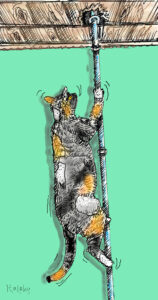 The access panel in the tenant’s bathtub was loose, and the cat had scurried down the pipe chase into the restaurant. I called the cops. “This is not an emergency,” I said. I explained the cat-in-the-restaurant was a one-off freakish thing and wouldn’t happen again.
“It better not,” the cop said.
I shouldn’t have called the city. That often muddies things.
Eventually an animal warden came around and got the cat, and the tenant picked up the cat.
And then a couple days later, the cat fell through the ceiling again. My handyman had apparently not screwed in the access panel tight enough. Or maybe the cat was a tiger.
We got longer screws. We’re OK for the moment. Cat is not on the menu.
February 3, 2026 2 Comments
NO POWERPOINTS!
I was butt-hurt when my wife disparaged my klezmer lecture that I had given to a group of senior citizens. She criticized me about this the other day, even though the lecture was more than a decade ago.
I had done an “edu-tainment” lecture at a JCC “LearnInn” retreat in 2011. I had gone light on the dancing (which Alice led) and heavy on the talking.
Alice, the lecture was not a concert. It was a lecture.
I’m doing a klez lecture next Wednesday at the Cleveland JCC. Alice wants to add a PowerPoint this time around.
I don’t do PowerPoints! Alice said she’ll assemble the PowerPoint. OK, maybe a couple photos of Yiddishe Cup from the good old days. That would be palatable. But no bullet points or text on screen — no way. I don’t need PowerPoint. I’m a good lecturer. I’ve been on stage a million times. I don’t read from notes. I have spoken at the national Yiddish Clubs conference. I was stellar at the Shaker Heights Unitarian Church. I take questions, I talk about klez, I play clarinet.
I don’t want too many pics of random shtetl Jews with violins!
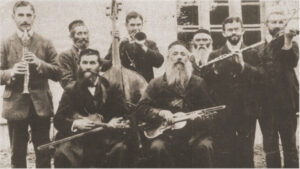
This is more fun:
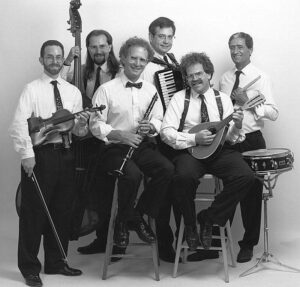
Yiddishe Cup. 1993
January 28, 2026 1 Comment
LIVING IN LAYERS
“[Cleveland:] . . . its population abandoned to their fate, left to freeze their ass off, standing in the dirty winter slush, waiting for a bus that is a long time coming. Somehow they go on living.” – R. Crumb, cartoonist.
“Are you going to Florida?”
That’s what I hear this time of year. My tennis partner is in Fort Lauderdale. My real estate broker is in Sarasota. My lawyer is in Jupiter, Florida.
And I’m in Cleveland, freezing. I have a box of disposable hand warmers, flannel-lined jeans and a Patagonia parka. The first snow of the winter is nice, but the 15th snow — not so nice. And this winter — it started way too early, around Thanksgiving. The temperature was 12 degrees lower on average, per day, in Cleveland through Christmas.
Am I complaining? Just a bit. I like it here. My mantra is that bad weather is no excuse for bad attitude. If you don’t like gray, move or get a sun lamp. We accomplish more in gray weather. The Scots and New Englanders didn’t invent stuff sitting at the beach.
I’m a landlord, and a tenant recently called City Hall because the heat was too low in her apartment. The city of Lakewood — where my buildings are — mandates 70 degrees. That seems high to me. I keep my own house at 68. At my tenant’s apartment, the boiler’s flame sensor was going out. When I got the city’s low-heat call, I thought about Florida.
For one thing, Florida runs in my family. My late father said the best years of his life were his final years, in Florida. My wife and I — and our then-young children — went to Florida every winter. It was a good deal; my parents paid for the airplane and watched the grandkids for a week, and the only thing my wife and I had to watch out for were the golf-cart crossings.
The minute the plane landed in Florida, my dad would bug me about real estate opportunities down south. Florida bedazzled my dad: how it was growing so fast. We weren’t in the Rust Belt anymore, Son. On the drive from the Fort Lauderdale airport, my dad said, “This was a two-lane dirt road when we got here. Now it’s six-lane.” Glades Road, Boca Raton. “And there’s a bagel store on every other block.”
“We have bagel shops in Cleveland, too,” I said.
The Snowbelt . . . Is this the worst winter we’ve had since the 1960s — when I was shoveling driveways for a buck? It feels like it. Lakewood reinspected my (formerly) cold building. We got the boiler cranking and the thermostat up to 80 degrees. The tenants were hot. That was better than another no-heat citation. I’m not looking forward to my next gas bills, which will be record-breakers.
I haven’t been in Florida for more than a decade, but I remember an ex-pat Clevelander down there accosting me in a restaurant with, “Why are you still in Cleveland?”
That meant: “Are you nuts? Do you like snow, gray skies, slush and potholes?”
I do. As the Scandinavians say, there’s no such thing as bad weather, just bad clothes. A second ex-pat Clevelander said, “The day I hit 62 years old, I had to leave Cleveland.” She was considering Arizona, too. “But Arizona doesn’t have an ocean, and I like water,” she said.
Lake Erie is water. Look it up. Cleveland is doable.
One last word: layers.
—
This essay appeared in today’s Cleveland Plain Dealer.
January 21, 2026 6 Comments
WHERE DID YOU GO
TO HIGH SCHOOL?
Mike, an old friend from high school, found me on the internet and pummeled me with questions about Cleveland real estate. He lived in Minneapolis. He ended by mentioning a few high school buddies’ names. He said, “I haven’t thought about high school in decades!”
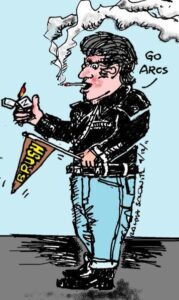
Was he bragging — as in I’ve moved on? I think about high school fairly often. Maybe because I live five miles from Charles F. Brush High. I also think about elementary school and preschool. And I didn’t even go to preschool! News: “Nostalgia has been shown to counteract loneliness, boredom and anxiety,” John Tierney, New York Times.
I go to class reunions even when they’re not mine — like Cleveland Heights High’s 50th. I was playing a klezmer gig at a massive, multi-room party center and went into an adjacent room for the reunion, just for the atmospherics: Go Heights Tigers.
I wish teachers were invited to reunions. In the 1990s, my 12th-grade English teacher walked his dog by my house almost daily in Cleveland Heights. One day I got up the nerve to say hello. And he didn’t remember me.
“I had so many students,” he said.
“I’ll bet you remember Ann Wightman!” I said.
Yes, he remembered Ann, the salutatorian. Ann got all As and one B. I think she purposefully got the B to let a boy be valedictorian. That’s how it worked back then (1968). Some smart girls didn’t want to stick out academically.
I haven’t been back to Brush High in a while. It’s off my flowchart. If I entered Brush, I would probably feel very young or very old. I think “very old” would win. Not worth it.
—
A guy named Mel called. He was considering my band for his daughter’s wedding. Right off he asked where I had gone to high school. That’s the go-to question here in Cleveland. Mel himself had graduated from Cleveland Heights. I answered and then segued into the main topic: “It doesn’t matter what you want musically. What about your daughter? She’s calling the shots for the wedding band.”
“Did you play sports at Brush?”
“Tennis.”
“Do you know Joel Schackne?” Mel asked. (Schackne had been a champion tennis player at Cleveland Heights High.)
“I knew of him. He’s older than me. Whose idea is klezmer music for the wedding, yours or your daughter’s?”
“Schackne is in Florida. He’s still playing tennis.”
“What does your daughter think?”
“What AZA were you in?” (AZA is a national fraternal organization for Jewish boys.)
“I wasn’t in AZA.”
“Who do you see?”
“A guy named Mickey — a goy,” I said. “You wouldn’t know him.”
Most of my high school friends left Cleveland decades ago. The guys remaining are, for the most part, entrepreneurs and family-business owners. A few made serious money here. The intellectuals hit the road.
Do I have any kind of post–high school life?
Maybe.
January 14, 2026 2 Comments
SEARCHING FOR GALICIA
One of my grandmother’s choice Yiddish expressions was “Geven-zhe nit a yold.” (Don’t you be a chump.) My grandmother — Toby’s mother — owned a candy store, raised four kids almost single-handedly, buried a three-year-old daughter, and during her retirement years, owned a four-suite apartment building. She was nobody’s chump.
Anna Soltzberg (née Seiger) occasionally called her grandchildren — like me — foyl (lazy). She lived at our house for a while. I called her Bub — short for bubbe (grandmother). Bub was not into baseball; she was into the card game casino, the television show Queen for a Day; borscht and boiled chicken. She could eat. She had sugar diabetes. She wore bubbe shoes.
I couldn’t figure out where Bub was from. She was from Galicia, she said. Spain? Galicia was also a province in Austria-Hungary. Bub was from a shtetl called Grodzisk. She came to America at 20.
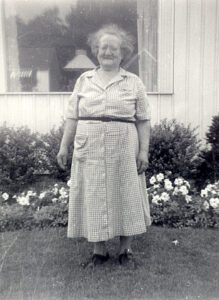
Anna Seiger Soltzberg (1884-1964). 1598 Laclede Rd., South Euclid, Ohio
In junior high I told my friends my grandmother was from Austria. Not exactly Vienna, to be sure. But “Austria” made sense to my friends.
Bub complained about the level of kashrut at my aunt’s house. Bub wanted my aunt not to keep kosher. Keeping kosher was too expensive. Bub was an apikoros (non-believer), socialist and cheap.
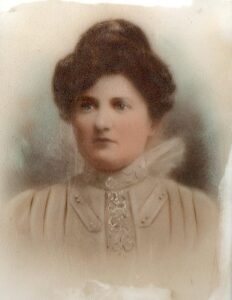
Bub around 1904, New York City.
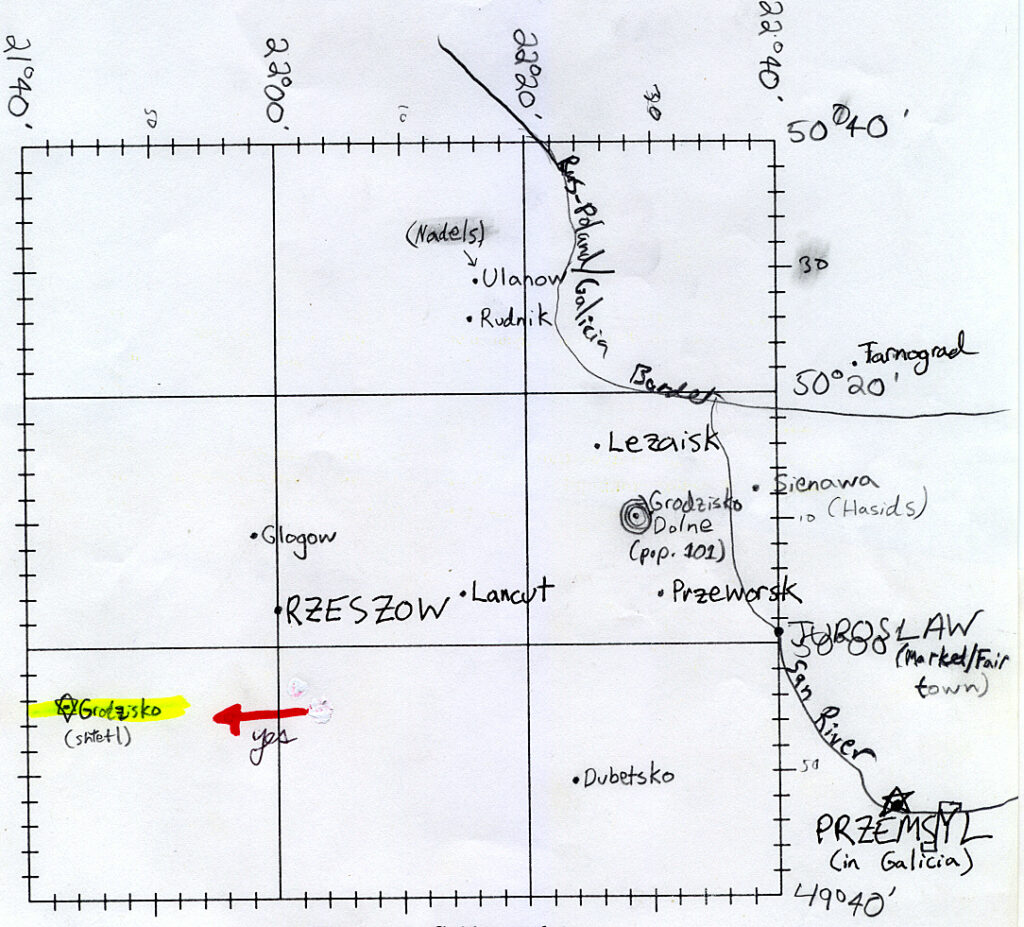
. . . Grodzisko, Galicia, Austria-Hungary. (The Yiddish name for the shtetl was Grodzisk, GRUD-zhisk) In the 1980s I located the shtetl on the Shtetl Finder map.
Grodzisk was about 60 miles west of Przemysl. The various shtetls had so many different names (Polish, Ukrainian, German, Yiddish). That was the tricky part.
I had a family postcard, postmarked “May 1, 1939, Grodzisko.” It was in Polish and said, “How are you?” On the flip side was a photo of a relative, Mili Seiger. The Germans invaded Poland four months after the postcard was mailed.
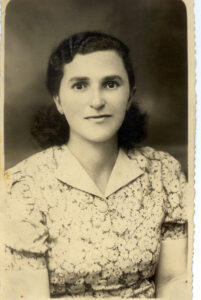
Mili Seiger, 1939, Grodzisko
I looked up “Mili Seiger” on the Yad Vashem online archives. There were so many Seigers, Siegers, Zygers, Zaygers and Zeigers, I couldn’t find Mili.
There are three types of Jews. Not Reform, Conservative and Orthodox. Try American, Israeli and victims of the Holocaust. Each about a third. These are my people.
—-
Plotting Grodzisko [Grodzisk] by Teddy Stratton, 1998:
January 6, 2026 3 Comments
