Category — Pekar
HUMOUR ME
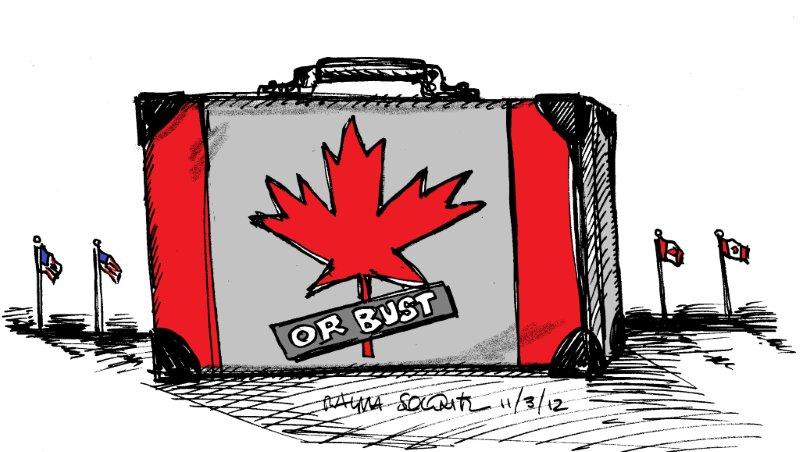
My friend Jeff — a social worker — was fixated on Canada. He watched “Hockey Night in Canada” on TV and studied the Canadian railroad timetables. He filled out immigration papers to Canada, waited several months for clearance, and moved to Ontario.
The next day he came back to Cleveland. He didn’t like his social work job up there, he said, but he liked Canada.
Jeff definitely didn’t like Cleveland — blasting car horns, boom boxes, leaf blowers, people giving you the finger, and his parents pestering him. On Mondays Jeff’s father would say, “You’re going to move too far away.” On Tuesdays his dad would say, “You need to go out into the world and prove yourself.”
I subscribed to “Hockey Night in Canada” on cable TV for Jeff, so he would babysit my then-toddler son, Teddy, for free on Saturday nights.
Jeff moved to Canada again. This time to Nova Scotia.
It worked. I haven’t seen Jeff in 31 years.
I miss him, even though he verbally abused me. He was misanthropic and jaded, and I was OK with that. We held jadedness contests. Jeff said I was a thrill-seeking diner on a perpetual hunt for dishes my bubbe never made. He said, “You crave urban experience so badly you would eat flankn cooked directly off the seat of a cross-town bus.” True enough.
We listened to comedy records, played music together, and made fun of our fellow landsmen. Back then Jeff knew more Yiddish than I did. His favorite curse was Gey mit dayn kup in drerd. (“Go to hell.” Literally “Go with your head in the ground.”)
We attended High Holidays at Case Western University Hillel. I had to drive; Jeff was anti-car, anti-noise, anti-everything. He was so annoyed.
I schlepped Jeff to a hillbilly bar on the near West Side so he could jam with the house band. He played guitar and sang a couple tunes. Jeff was devoted to country music — anything “authentic” (the watchword of our faith). Jeff’s favorite player was Hank Williams.

Lake Erie gets you there: Canada, 57 miles. (Cleveland shoreline.)
Jeff’s sole East Side musical appearance was at the Heinen’s supermarket in University Heights for a cancer-awareness fundraiser. He played “Good Old Mountain Dew” in the soda pop section and “Hava Nagila” by the oranges. He had a sense of place.
And he moved to Canada.
October 7, 2026 1 Comment
PEKAR TRIBUTE DAY
Every once in a while I go full Harvey Pekar. Like yesterday, when I spent half the day running bummer errands and waiting in lines. I had three missions: new driver’s license, new passport, flu shot. Wait, it gets interesting. Slightly. For example, I took an envelope from the Huntington Bank ATM lobby and the envelope had a $30 check in it — payable to the Ohio Treasurer from a tailor, dated a year ago. My son Ted took the check to the tailor shop, and the guy was happy to get it.
Bureau of Motor Vehicles. I registered online, so I got to cut in front of the 30-or-so people waiting in line on the sidewalk, social distancing. On my way out, I told everybody, “In and out — A to Z — in 30 minutes. Go home and sign up online.” Nobody moved.
Flu shot. CVS couldn’t pull up Medicare on its screen so I left. I went back to the bank. The line was still long there, so I slipped my dough in the night drop. I had cash, which is a bit risky to “drop,” but so far no problems — and “so far” for me means the last four decades. I wouldn’t slip 5K cash in a night drop, but I’m pretty sure plenty of retail merchants do.
CVS reprise. The Medicare computer connection was now working. I told the shot administrator he had the voice and demeanor of a doc, and he was flattered. I thought he was a clerk. No, he was a doctor of pharmacology. “Did you go to Ohio Northern?” I asked. Bullseye. He said, “How’d you know that?” Ohio Northern = pharmacy.
My passport photo doesn’t look so good, but hey, I’m 70, and the government doesn’t let you wear glasses now. My wife got hers, too, and she said hers is worse. I told the passport-photo taker, “I guess I’m not 35 anymore.” Like a lot of old guys, I like to BS with clerks. I hit it off with everybody yesterday but the BMV ladies. I bragged to a BMV clerk, “This is an original social security card from 1961.” She didn’t care. My dad had gotten the card for me when he bought me two shares of GTE in 1961. (GTE eventually became Verizon.) The card is crisp and has never been in a wallet. It’s got my childhood address and postal zone (as opposed to ZIP code) on it. Did you read this far? Pekar would have gotten you this far.
October 14, 2020 6 Comments
STANDING IN LINE AT THE BMV
Do I get new plates or keep my 2003 Ohio bicentennial plates?
Whichever is easiest.
Entering the Bureau of Motor Vehicles, I had Harvey Pekar-level anxiety. But I lucked out; I was a plate transfer, not a new driver’s license, so I got to skip to the head of the line.
I had bought a Subaru Legacy and sold my Ford Fusion. Both cars are red, so nobody knows I have a new car. A disappointment. I wanted a blue car, but the Subaru Legacy doesn’t come in blue. I refuse to drive gray, silver, black or white. I miss the purple on the Plymouth Duster.
I was in and out of the BMV in 15 minutes. Can you beat that? I accidentally left one of my plates on the counter and a clerk ran out, yelled “sir” at me, and handed me the plate. I said to her, “At least I got you outside! Thanks.” It was 20 degrees and snowing. She said, “I don’t want to be outside.” The BMV. I miss Harvey Pekar.
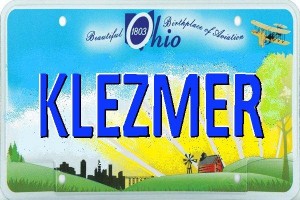
Not my plate, btw.
March 13, 2019 3 Comments
RETURN OF THE MAGGIES
Maggies were linoleum salesmen/hustlers in Cleveland. “Maggie” is derived from Magnoleum, a flooring brand. Harvey Pekar wrote a comic strip about maggies in 1982. I didn’t hear the word maggies again until recently, when my cousin Danny Seiger expounded: “The maggies carried thick samples of linoleum that looked like Venetian marble. They sold nine-by-twelve sheets for fifteen dollars. Nobody had fifteen dollars back then, so the maggies took five bucks on installment, and came back with a roll of tissue-paper. They could carry it upstairs real easy. It weighed three pounds. The maggies laid the tissue-paper linoleum on your kitchen floor, collected the five bucks, and never came back.”
The maggies sold more than linoleum, Danny said. They sold ties at barbershops and socks at saloons. Each maggie had a territory and a product line.
I Googled “Maggies” after my cousin Danny left. Maggies, an Irish music group, popped up. Then I tried “Maggies + Pekar” . . .
Michigan State University Libraries,
Comic Art Collection.
“The Maggies: Oral History”/story by Harvey Pekar;
art by R. Crumb. 2 p. in American Splendor, no. 7 (1982).
I phoned Danny Seiger and read the Pekar story to him. I wanted to know if Turk’s deli — where the maggies hung out in Harvey’s comic — was the same place as Seiger’s deli. Danny said, “Turk’s was at One-hundred Seventeenth. We were at One-hundred Eighteenth.”
I said, “There were two delis right next to each other? How many delis were there in Cleveland?”
“There were seven on Kinsman, and twenty-eight in Cleveland in the 1930s,” Danny said.
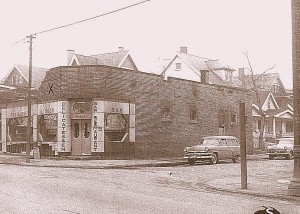
Seiger’s, 1958, (with fire damage)
–
A version of this first appeared here 8/4/10.
August 30, 2017 3 Comments
A LOVE SUPREME
The Jazz Temple was a former Packard showroom at Mayfield Road and Euclid Avenue. Coltrane and Dinah Washington 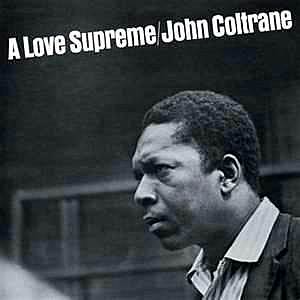 played there. The Jazz Temple was in business from 1960 to 1963. I passed the Jazz Temple weekly on my way to Sunday school at The Temple, the gold-domed Reform temple in University Circle.
Rabbi Abba Hillel Silver was the head rabbi at The Temple. He once spoke at the United Nations, advocating for the founding of the State of Israel. Rabbi Silver’s son, Dan, was the assistant rabbi. Dan played football at Harvard and occasionally wrote for the Cleveland Edition.
At Sunday school, kids were mostly from Shaker Heights. One kid got a ride in a limo to temple. The driver wore a chauffeur’s cap. The limo wasn’t a Rolls; it was a Buick station wagon.
I couldn’t grasp how temple — the word — fit into the Jazz Temple. Was Jazz a religion too? Many years later, I met former beatniks who had actually gone to shows at the Jazz Temple.
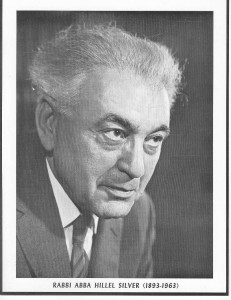 The Jazz Temple was blown up in 1963. Somebody didn’t like the club or the owner, Winston Willis, a controversial black businessman. At The Temple religious school, we students attended services every Sunday morning to hear Rabbi Silver. (Services were on Sunday, not Saturday, in the 1950s at Silver’s.) Rabbi Silver looked like God. Nowadays, at The Temple East in Beachwood, there is a Abba Hillel Silver memorial study. The rabbi’s desk is laid out like he just stepped out for lunch. He died in 1963, just six days after Kennedy got murdered.
—
A slightly different version of this appeared 9/5/12. If you need baseball stuff, see my story at City Journal.
November 2, 2016 5 Comments
LONG AND DEEP
I don’t purposely visit graves of famous people, but I do bump into those graves on occasion. Harvey Pekar is buried next to Eliot Ness at Lake View Cemetery. I happened to be at the cemetery and asked about Harvey’s grave. A docent said look in section 7, lot 9-0, but there was nothing there, just a stick. This was a few years ago. Now there’s a tombstone.
At John D. Rockefeller’s grave, there was a quarter on the base of the monument. A tour guide said visitors sometimes put money on John D’s grave. The money is in repayment for the dimes Rockefeller gave out to kids, the guide said.
I saw a tombstone with a Jewish star at Lake View. I think I could go long and deep at Lake View, or I could go next door to Mayfield Cemetery, which is Jewish, but for that I’d have to rejoin Temple-Tifereth Israel for the cemetery plot. Or I could use my cousin’s unused plot out at Hillcrest Cemetery, where my parents are buried. Also, I could go to Park Synagogue’s cemetery, but my wife prefers Lake View. So I’ll probably go there.
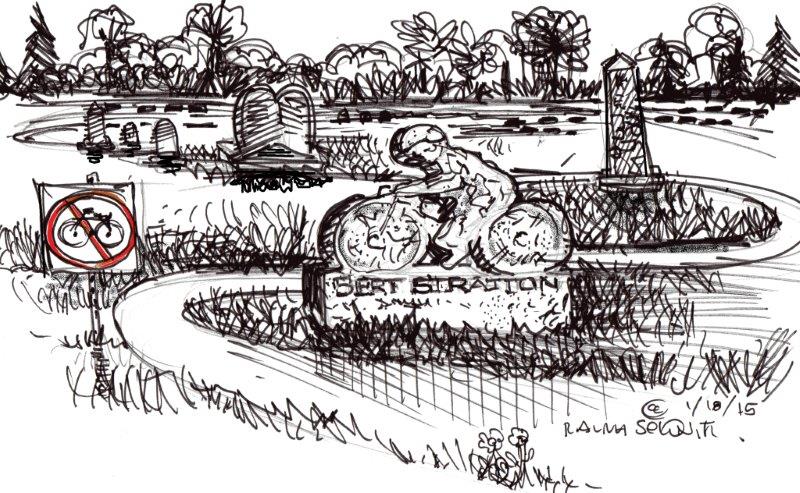
My main beef with Lake View is they don’t allow bikes. Cars are OK, but if a biker goes through Lake View, the management has a conniption. The cemetery has steep hills and the management is afraid of bike-car collisions.
Let me think about Lake View. Give me some time.
April 27, 2016 3 Comments
BOOK LIST
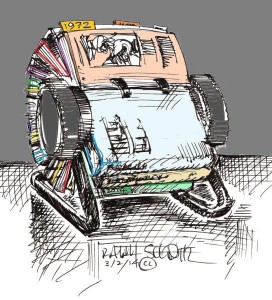
Pamela Paul, editor of the New York Times Book Review, keeps a list of all the books she has read. She wrote about her list — that goes back to 1988 — in the book review.
I know somebody else who keeps a list.
My list goes back to 1973, Ms. Pam Paul! (Actually 1971, but I can’t find the 1971-72 portion right now.)
My four literary horsemen of the early 1970s were Kerouac, Saroyan, Thomas Wolfe and Henry Miller. Plus every beatnik writer. Every beatnik. That included Dutch motorcyclist/writer Jan Cremer and Turkish East Village beat Erje Ayden.
Here is my 1974 list, edited:
The First Circle Alexandr Solzhenitsyn
Geronimo Rex Barry Hannah
Kentucky Ham William Burroughs Jr.
Confessions of a Child of the Century Thomas Rogers
Strangers and Brothers C.P. Snow
The Manor Isaac Bashevis Singer
Pere Goriot Honore de Balzac
Tropic of Cancer Henry Miller
Blue Movie Terry Southern
Monday the Rabbi Took off Harry Kemelman
I’m Glad You didn’t Take it Personally Jim Bouton
Call It Sleep Henry Roth
My Friend Henry Miller Alfred Perles
The Wanderers Richard Price
Imaginary Speeches for a Brazen Head Philip Whalen
Franny and Zooey J.D. Salinger
The Boys on the Bus Timothy Crouse
Nine Stories J.D. Salinger
The Autograph Hound John Lahr
Raymond Chandler Speaking Raymond Chandler
Lolita Vladimir Nabokov
My Last Two Thousand Years Herbert Gold
The Slave Isaac Bashevis Singer
***
Did you skim or read that list? If you read it, here’s your reward — a continuation, with asterisks for really funny books. (At the end of the list, there is a prose wrap-up.) My fav books, generally . . .
1975
Keep the Aspidistra Flying George Orwell
Burmese Days George Orwell
Fear of Flying Erica Jung
A Fan’s Notes Frederick Exley
The War Against the Jews Lucy Dawidowicz
’76
Little Big Man Thomas Berger
Hot to Trot John Lahr *
The Fight Norman Mailer
Miss Lonelyhearts Nathanael West
The World of Our Fathers Irving Howe
Bloodbrothers Richard Price
The Rise of David Levinsky Abraham Cahan
Tales of Beatnik Glory Ed Sanders
The Idiot Fyodor Dostoyevsky
’77
While Six Million Died Lucy Dawidowicz
Thirteenth Tribe Arthur Koestler
Chrysanthemum and the Sword Ruth Benedict
The Last Tycoon F. Scott Fitzgerald
Confessions of a Nearsighted Cannoneer Seymour Krim
’78
Union Dues John Sayles
All My Friends are Going to Be Strangers Larry McMurtry
The Chosen Chaim Potok
A Feast of Snakes Harry Crews
The Basketball Diaries Jim Carroll
’79
The Cool World Warren Miller
Rabbit Run John Updike
Airships Barry Hannah
The Rector of Justin Louis Auchincloss
Sophie’s Choice William Styron
King of the Jews Leslie Epstein
’80
The Pope of Greenwich Village Vincent Patrick
Dubin’s Lives Bernard Malamud
The Apprenticeship of Duddy Kravitz Mordecai Richler *
The Right Stuff Tom Wolfe
Tess of the d’Urbervilles Thomas Hardy
’81
Jane Eyre Jane Austin
The House of Mirth Edith Wharton
Ethnic America Thomas Sowell
’82
Zuckerman Unbound Philip Roth
Maiden Rites Sonia Pilcer *
The Friends of Eddie Coyle George V. Higgins
’84
God’s Pocket Pete Dexter
Rabbis is Rich John Updike
This Way for the Gas Tadeusz Borowski
The Abandonment of the Jews David Wyman
Survival in Auschwitz Primo Levi
’85
Man’s Search for Meaning Viktor Frankl
The Headmasters Papers Richard Hawley
Bright Lights Big City Jay McInerney
The Art of Fiction John Gardner
Fathers Playing Catch with Sons Donald Hall
La Brava Elmore Leonard
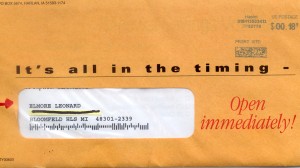
Elmore Leonard junk mail
’86
Babbitt Sinclair Lewis
Wiseguy Nicholas Pileggi
Providence Geoffrey Wolff
’87
The Sportswriter Richard Ford
The Great Pretender James Atlas
Bonfire of the Vanities Tom Wolfe
’88
Papa Play for Me Mickey Katz
Life is with People Mark Zborwski and Elizabeth Herzog
The Facts Philip Roth
A History of the Jews Paul Johnson
In Praise of Yiddish Maurice Samuel
’89
Old New Land Theodor Herzl
Architects of Yiddishism Emanuel Goldsmith
From that Place and Time Lucy Dawidowicz
’90
Paris Trout Pete Dexter
’91
Patrimony Philip Roth
Mr. Bridge Evan Connell
’92
Devil’s Night Zev Chafets
Rabbit at Rest John Updike
Rabbit Redux John Updike
’93
Class Paul Fussell
Days of Grace Arthur Ashe
’94
Lost in Translation Eva Hoffman
How We Die Sherman Nuland
Roommates Max Apple
’96
Moo Jane Smiley
Independence Day Richard Ford
The Road from Coorain Jill Kerr Conway
’97
Parts of My Body Phillip Lopate
American Pastoral Philip Roth
The Wishbones Tom Perrotta
’99
Ex-Friends Norman Podhoretz
Hole in Our Soul Martha Bayles
’00
The Trouble with Cinderella Artie Shaw
The Human Stain Philip Roth
Winning Ugly Brad Gilbert
’01
Up in the Air Walter Kirn *
’02
John Adams David McCullough
Selling Ben Cheever Ben Cheever *
The Corrections Jonathan Franzen
The New Rabbi Stephen Fried
’03
Samaritan Richard Price
Funnymen Ted Heller *
My Losing Season Pat Conroy
Fabulous Small Jews Joseph Epstein
The Case for Israel Alan Dershowitz
’04
The Da Vinci Code Dan Brown
Good Vibes Terry Gibbs
’05
Made in Detroit Paul Clemens
’06
On Beauty Zadie Smith
Prisoner of Trebekistan Bob Harris
High Fidelity Nick Hornby
Sweet and Low Rich Cohen
’07
America’s Polka King Bob Dolgan
Prisoners Jeffrey Goldberg
Infidel Ayaan Hirsi Ali
’08
A Random Walk Down Wall Street Burton Malkiel
Lush Life Richard Price
Dean’s List Jon Hassler
Irrational Exuberance Robert Shiller
’09
Rabbit at Rest John Updike
How I became a Famous Novelist Steve Hely *
Facing Unpleasant Facts George Orwell
’10
The Great Indoors Eric Broder *
Pops Terry Teachout
Olive Kitteridge Elizabeth Stout
’11
I Feel Bad About My Neck Nora Ephron
Open Andre Agassi
How to Win Friends Dale Carnegie
The Whore of Akron Scott Raab *
’12
I Married a Communist Philip Roth
Pocket Kings Ted Heller *
’13
The Love Song of Jonny Valentine Teddy Wayne *
***
I bought the Richard Price books for pleasure and investment purposes. His books are probably worth nothing. I have followed Price’s career since he was 25. I knew a woman who dated him at Cornell. Price is a Lit god around my house.
I like short books. Most classics are long, so I’m bad at classics. Funny books are my favorite. Throw in a few jokes, or lose me. I don’t need a strong plot.
I’ve read The Great Gatsby five times because it’s great and short. I would read it more often if it was funny.
I can’t remember most of what I read.
A lot here — in this post — is a rip off of Nick Hornby and his Ten Years in a Tub, about books Hornby has read in the past 10 years.
I haven’t read much philosophy. Any? I’ve tried the Bible a few times. Proust — I’ve done 50 pages with him. I’m good with Shakespeare!
I haven’t read The Hobbit or War and Peace. (Check out Buzzfeed’s “22 Books You Pretend You’ve Read but Actually Haven’t.”)
I’ve read many books about Cleveland. Here are three random CLE books: A Fares of a Cleveland Cabby, Thomas Jasany; Confused City on a Seesaw, Philip W. Porter; and First and Last Seasons, Dan McGraw. I’ve read all of Harvey Pekar. Harvey didn’t write much. Maybe 90,000 words total. Thanks, Harvey.
I’ve read every klezmer book, I think. Did you know a Polish academic, Magdalena Waligorska, cited this blog in her book Klemzer’s Afterlife (Oxford University Press)?
My wife occasionally takes my literary recommendations to her book club. But not lately. She recommended How I Became a Famous Novelist by Hely. That ruined my wife’s credibility.
If you read a book on this list, pick one with an asterisk. And if you don’t think the book is funny, bail immediately.
I’m bailing. Gotta list something. What, I don’t know. Maybe I’ll tally the people who liked this post vs. those who thought it was too self-indulgent.
March 5, 2014 12 Comments
I BRAKE FOR ETHNICITY
1.
Yiddishe Cup has shared the stage with the Hungarian Scouts, Ukrainian Kashtan dancers, and Csardas, a Hungarian troupe. These groups draw fans to local festivals, and the dancers perform in difficult odd meters. Yiddishe Cup doesn’t draw many fans to these multicultural shows. The typical Jew doesn’t want to watch Ukrainians, Poles, or Hungarians dance.
At one festival, some of the folk dances had sappy English titles, like “My Little Cherry Tree” and “I Love You, Shepherd Boy.” I took the printed program home and looked up the real titles:
“Tylko We Lwowie” (Let’s Get Out of Lviv)
“Frogisic Sie Pani” (My Bagpipes are Soggy)
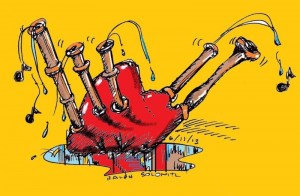
“Jaz Pa Ti” (Dad is Tipsy)
“Pytala Sie Pani” (Pierogis With Butter, Senator)
“Llactosi Nyasa Pilsenioya” (I Hate Milk and Like Beer)
“Jak Szybko Hund Chwile” (Jacko’s Chili Dog Is Outstanding)
“Nasza Jest, Noc Tylko” (Not Tonight, Not Tomorrow.)
2.
I bought a raffle ticket for the St. Mary’s Church (Collinwood) fundraiser, Catholic Order of Foresters, Court #1640.
I bought the ticket from Stan. Stan’s father was Stan too. Stan — my friend Stan – got married at St. William’s Church, not St. Stan’s. (St. Stan’s church is Polish. Stan is Slovenian.)
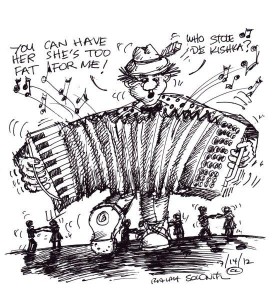 Stan’s wedding reception was at the big Slovenian National Home on St. Clair Avenue at E. 65th Street. Stan hired his uncle’s polka band. At the wedding, we danced Slovenian-style polka — not the same as Polish-style polka. (If you don’t know the difference, please see Harvey Pekar’s “Polka Wars” American Splendor, issue #16.)
Yiddishe Cup can play Slovenian! We’ve done Yankovic’s “Just Because” and “Blue Skirt Waltz,” and some charts from polka musician Joey Tomsick.
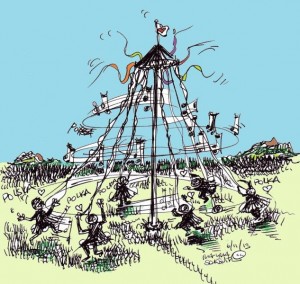
I won $20 in the St. Mary’s raffle. I haven’t seen the money yet.
Slovenians are tight with a buck. That’s their in-group reputation. Amongst themselves, Slovenians brag about their frugality, and they like to trash Lithuanians, who are even tighter. Stan told me all this.
The St. Mary’s Church raffle was three years ago. Stan, you owe me $23 — that’s $20 plus interest. Pay up, Stan. Any Stan.
September 25, 2013 6 Comments
HUMOUR ME
My friend Rob, a social worker, was fixated on Canada. He watched “Hockey Night in Canada” on TV and studied the Canadian railroad timetables. He filled out immigration papers to Canada, waited several months for clearance, and moved to a small town in Ontario.
The next day he came back to Cleveland. He was a mama’s boy, I figured.
He didn’t like the social work job, he said, but he liked Canada.
Rob definitely didn’t like Cleveland — the blasting car horns, the boom boxes, the leaf blowers, and his parents pestering him. One day Rob’s father said, “You’re going to move too far away.” The next day his dad said, “You need to go out into the world and prove yourself.”
I subscribed to “Hockey Night in Canada” for Rob, so he would babysit my then-toddler son for free on Saturday nights.
Rob moved to Canada again. This time to Nova Scotia. Change your place, change your luck, as the Hebrews sages say.
It worked. I haven’t seen Rob in 18 years.
I miss him, even though he verbally abused me. He was misanthropic. He was jaded. No, I was jaded. We held jadedness contests. Rob said I was restaurateur on a perpetual hunt for dishes my bubbe never made.
He said, “You crave urban experience so badly you would eat flankn cooked directly off the seat of a cross-town bus.”
True enough. So would he.
Rob and I listened to comedy records, played music together, and made fun of Jews. Rob knew more Yiddish than I did back then. His favorite curse was Gey mit dayn kup in drerd. (Go to hell. Lit., go with your head in the ground.)
We attended High Holidays at Case Western University Hillel. I had to drive; Rob was anti-car, anti-noise. He was so sensitive — probably the most sensitive person I’ve met, and that includes Harvey Pekar, who was not exactly loosey goosey on the avenue.
I schlepped Rob to a hillbilly bar on the near West Side, so he could jam with the house band. He played guitar and sang a couple tunes. Rob was devoted to country music — authentic country. Rob’s favorite player was Hank Williams.
Lake Erie gets you there: Canada. 57 miles. (Cleveland shore, Feb. 2013)
Rob made his sole East Side musical appearance at Heinen’s supermarket for a cancer-awareness fundraiser. He played “Good Old Mountain Dew” in the pop section and “Hava Nagila” by the oranges. He had a sense of place.
And he moved to Canada.
I wonder what he’s up to. He has family in Cleveland. He visits here, I imagine.
Rob doesn’t call. He doesn’t write. He doesn’t humour me.
—
“Rob” is a pseudonym.
—
At CoolCleveland.com today, “The Kid from Cleveland.” About a “kid” I ran into in Atlanta.
—
Extreme Canada is England. Here’s a video about England. (A Klezmer Guy rerun.)
March 13, 2013 No Comments
SCHOOLBOARDING (TORTURE)
I interviewed for a position on the library board.
I like to read, and I know two people who have been on the board and liked it.
I wondered, “Will the school board ask me what books I’m reading?” (The school board oversees the library board.)
In 1967 at Johns Hopkins’ admissions office, I talked about my Holocaust reading. The Holocaust wasn’t yet the “Holocaust.” I made a good impression in Baltimore, I think. (I was pre-med.)
Re: the library board interview. I recently read How Music Works by David Byrne and Shit my Dad Says by Justin Halpern. I have also read to page 100 in Malamud’s A New Life, a novel about a college instructor. For the first fifty pages, I was interested in the goings-on of a 1950s college English department. Then less so.
Nevertheless, “I’m reading Malamud” might be the ticket.
The members of the school board sat on a dais at the board of education building, and I took the “witness stand” in the center of the room. Only three school board members — out of five — showed up. One MIA board member was a playwright; the other, a guy from my synagogue. My A-team was absent!
Question 1: How would you make the library better for students?
Students? They are the species who play computer games and horse around in the teen room? I’ve been in that room, like, never. “I would maintain the library as a first-class multicultural, multimedia center,” I said.
Question 2: What do you do at the library besides take out books?
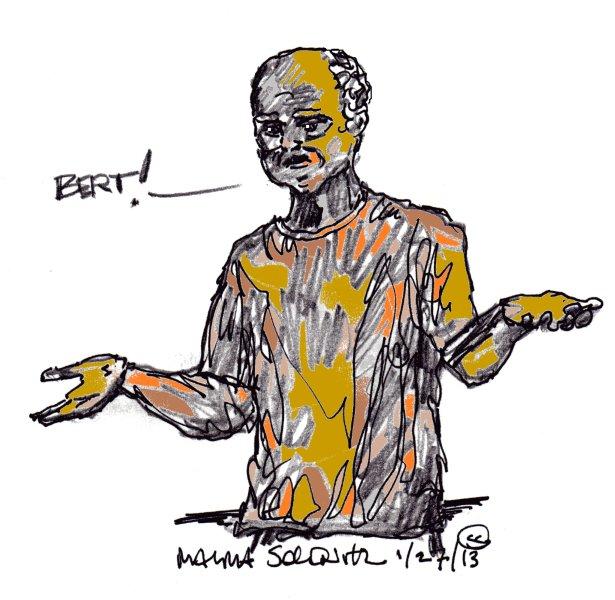 Not much! “I was at the dedication of the Harvey Pekar statue,” I said.
Question 3: What would you do to help the library’s finances?
“I vote for the levies.” What about Malamud?
Question 4: Are you willing to commit to a seven-year position?
“Yes, but actuarially speaking, who knows.”
A chemist beat me out for the job. In an email, the library director thanked me for applying and encouraged me to apply again.
First I need to walk through the teen room and get a better feel for the young adults’ needs. I’ll do that right after I finish Malamud’s A New Life.
—
Side B
MR. OO
I got a call from Oo (rhymes with “boo”), looking to open an Asian food market.
I said, “How do you spell that?”
“O, O.”
“O, O, 7?”
“Yes. Hah-hah.”
“Is Oo your first name.”
“No, that’s Kyawswar.”
“You Chinese?”
“No, I’m from Burma.”
“Close enough,” I said.
“Yes, very close.”
“Is this going to be an American mini-market or an Asian market?” I said. “I don’t want 40-ounce malt liquor and cigarettes.”
“Asian market, sir. Our people like rice, the vegetables, avocados. Maybe cigarettes. The high school boys from the school [across the street] buy the fruit juices.”
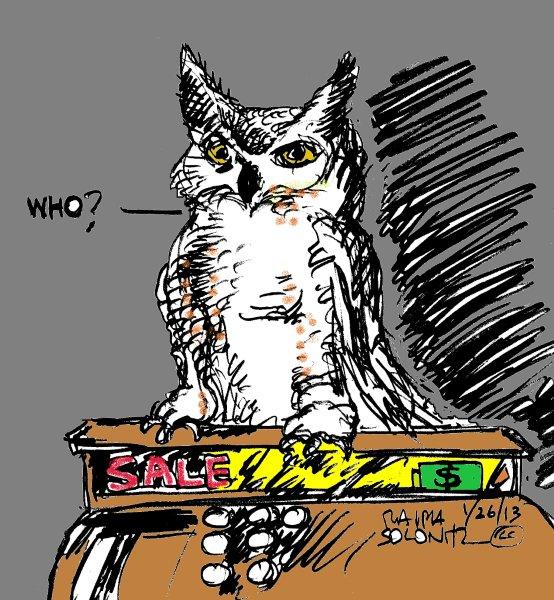 Oo rented the store. He’s industrious. He owns two sushi stands at Giant Eagles. That’s not all . . .
I told my wife, “Oo had a nail salon.”
“Who?” she said.
“Oo.”
—
Footnote: Consider “U Thant,” the former UN secretary general from Burma. Thanks to Ted Stratton for this U/Oo connection.
—
Byliner chose my essay “The Landlord’s Tale” (City Journal) as one of the top 102 nonfiction journalism pieces of 2012. Read the essay here.
January 30, 2013 3 Comments
I’M TWICE AS OLD AS YOU
I liked to provoke my mother-in-law. She would say, “They’re wearing their hair high in the 1940s look.” And I would say, “Who’s they?” Or she would say, “I don’t have any shoes to wear tonight to the party.” And I would say, “You going barefoot?”
I shouldn’t have been such a smart aleck. I hung around Harvey Pekar, who was inspirational — very bitter. “I’m hateful,” he said. “I’d like to have a cool way to slip my George Ade article to Lark [Pekar’s second ex-wife, an academic]. She’s small-minded. Who wants to dig through Ade’s school grades? So what. I want to do something more creative.”
This was in 1981.
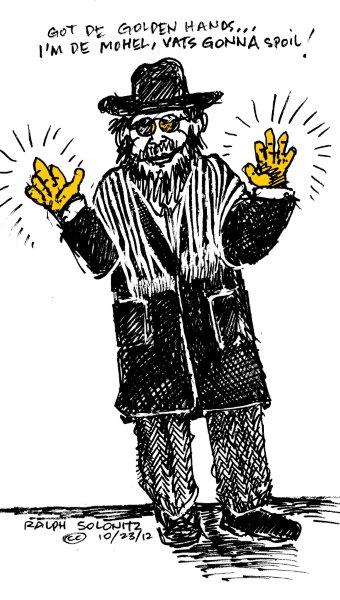 Now I’m twice as old as my son Ted. Exactly twice as old. He’s 31. Pekar was at Teddy’s bris. Pekar considered writing a comic about the mohel raising his hands like a prize fighter and saying, “Golden hands!”
Ted has been a newspaper reporter and taught English in Korea. He has a law degree. He was on Jeopardy. He has worked temporary crap jobs, too. He has done a lot, but he’s still only half my age!
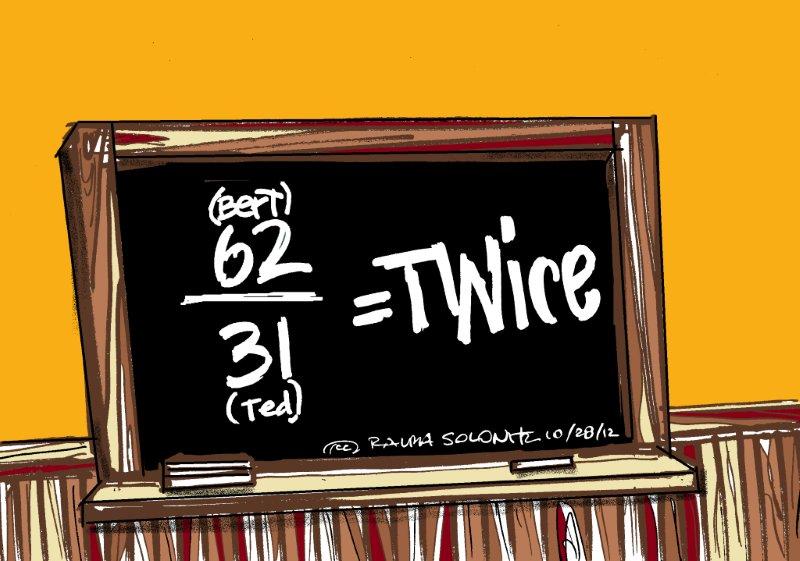
Here’s what I’ve learned in the past 31 years:
1. Guard against bitterness
2. Make your job interesting
3. Do something beneficial for others
4. Zekhor (Remember)
5. Get married and have kids
6. “Don’t just view it, do it” (Shari Lewis)
7. Old people are dumb! (joke)
8. Don’t judge people by bumper stickers, neighborhoods, or their tastes in music.
I hope to list 10 items by the end of the decade. (Make it to the end of the decade, then worry about the list, dude.)
***
When my youngest child, Jack, moved to California last year, I held a mini-shiva; I walked through the music room in the basement and threw out old mic cables, cassette tapes and tons of drumsticks.
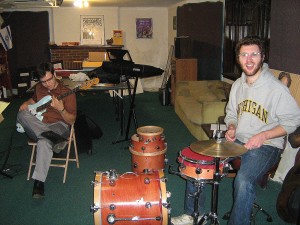
Eli “Paperboy” Reed (L) and Jack Stratton down the basement, 2011
Jack took his drums and an electric bass out west. I called him when he was driving through Nebraska, and said, “Did you open the letter I wrote you?”
“Yeah,” he said, “my friends thought it was funny that on the envelope you wrote, ‘Don’t open till Nebraska.’ They thought it contained hallucinogenics.”
I’m anti-drugs! I was dispensing wisdom-in-a-can (in an envelope) to my youngest child. If he could combine my old guy’s experience with his 24-year-old’s enthusiasm and creativity, he would do fine. [Story about the letter is here.]
I filled up four contractors garbage bags in the basement.
I hauled the stuff to the tree lawn on garbage day. An hour later, three bags were gone, but the fourth remained. A junk man had picked up three bags. And I had put some paperwork in those bags, as well as Jack’s garbage.
Mac — the junk guy — pulled up the next week in a pickup truck. He said he liked my trash, particularly the ersatz medieval knight’s helmet from my son’s high school days.
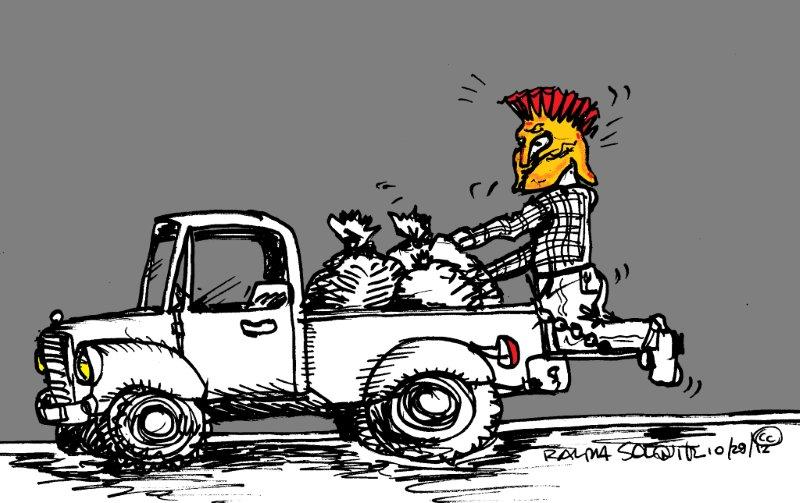
I said, “What about the paperwork?”
He said he had pitched that. Good. I didn’t want my identity stolen that day. He handed me his card.
Age 24 is when you have the least amount of possessions. Now Jack has even less –- four bags less.
And Mac has some good stuff, like the helmet.
—
Yiddishe Cup is at the College of Wooster (Ohio) 9:30 p.m. Sat. (Nov. 17). More info here.
November 14, 2012 5 Comments
A LOVE SUPREME
The Jazz Temple was a music club in a former Packard showroom at Mayfield Road and Euclid Avenue. Coltrane played there. Dinah Washington too. Everybody played there. The Jazz Temple was in business from 1960 to 1963.
I passed the Jazz Temple weekly on my way to Sunday school at The Temple, a Reform synagogue in University Circle, Cleveland.
Rabbi Abba Hillel Silver was the head rabbi at The Temple. Rabbi Silver was very prominent; he spoke at the United Nations, advocating for the establishment of the state of Israel. Rabbi Silver’s son, Danny, was the assistant rabbi. He played football at Harvard and blocked hard for his dad.
The Sunday school kids at The Temple were mostly from Shaker Heights. One kid got a ride in a limo to shul. The driver wore a chauffeur’s cap.
I couldn’t grasp how temple — the word — fit into a non-Jewish setting, like in “Jazz Temple.” Was Jazz a religion too? (Give me a break. I was 10.)
Years later, I met a couple ex-beatniks who had been old enough to go to the Jazz Temple in the early 1960s. They had heard Trane and Ella.
The Jazz Temple was blown up in 1963. Somebody didn’t like the club, or the owner, Winston Willis, a controversial black businessman.
At The Temple, the religious-school kids would attend the last part of the service and hear the sermon. Rabbi Silver looked like God and talked like Him.
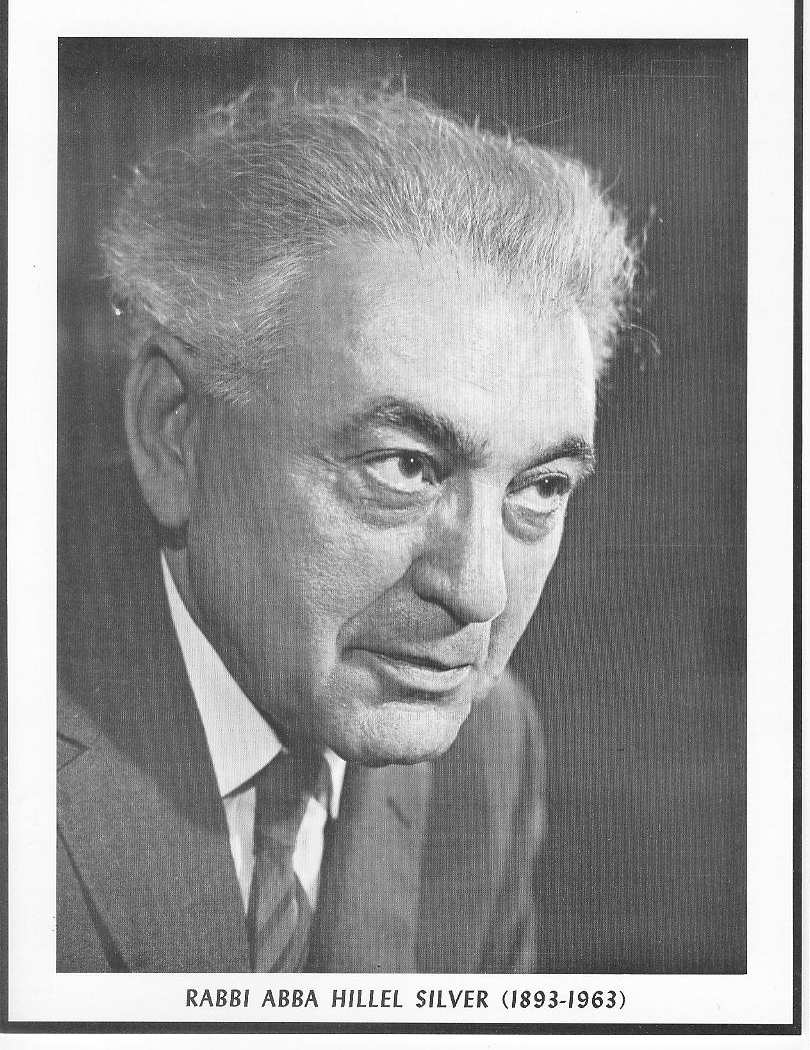 Today, at The Temple East in Beachwood, there is an Abba Hillel Silver memorial study. The rabbi’s desk is laid out like he just stepped out for lunch. He died in 1963.
Rabbi Silver: Live at the Jazz Temple. Interesting.
John Coltrane: Live at The Temple. Another possibility.
A love supreme . . .
A love supreme . . .
—
SIDE B
PRECIOUS
In the arts, if you’re precious, you’re bad. Precious is the worst thing. Precious means you’re dainty and overly refined.
A friend (a former music critic) called all college a cappella music precious.
Harvey Pekar called Willio and Phillio — the Cleveland music-comedy duo — precious. (Willio and Phillio was around in the 1980s.) Willio and Phillio was precious — their stage name for sure. Willio (Will Ryan) went out to Los Angeles to work for Disney, and Phillio (Phil Baron) became a cantor in L.A. They were good, and probably still are.
Yiddishe Cup is precious occasionally. The musicians say “oy vey” too much on stage. I’ve tried to get my guys to stop. I can’t.
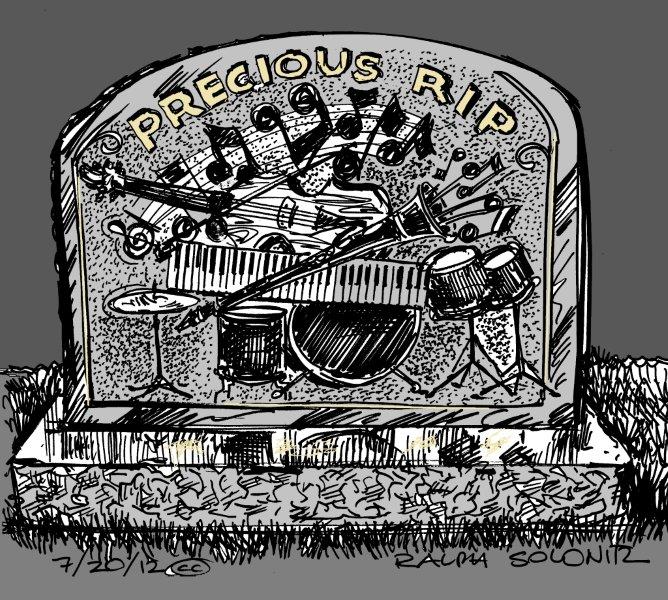
Peter Laughner, a Cleveland rocker, died from drug abuse and alcoholism at 24. He killed himself, basically. (This was in 1977.) He was not precious. He was dead — and funny — about art. He was in the Pere Ubu underground before Pere Ubu was famous.
Suicide doesn’t appeal to me for two reasons: 1) My wife would kill me if I tried it. 2) I want to attend my kids’ weddings and eventually meet my grandkids-to-be.
“Precious” is OK for grandkids. (“Grandkids” is precious.)
—
SIDE C
New construction — Side C — for Michiganders. . .
THE LODGE
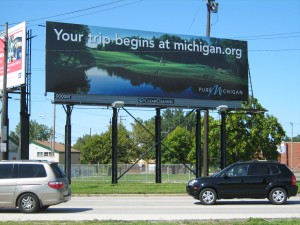
Chester Ave., Cleveland, 2011
I drove to Rochester, Michigan, which is not as cool as Rochester, New York, but it does have a small-town charm.
I’ve seen Father Coughlin’s former church in Royal Oak, Michigan.
I’ve been to Detroit many times.
My wife, Alice, said, “Detroit has very long roads.”
She probably meant Woodward, Gratiot and Telegraph.
Detroit also has the Lodge. Elmore Leonard mentions the Lodge in his books, like, “The gambling casino, Mutt, you can’t fucking miss it, over by the Lodge freeway.”
A couple Cleveland freeways and bridges have names, like the Bob Hope Memorial Bridge, but nobody ever uses the names.
I stayed at a hotel near the Silverdome, which looked like a big pillow. (The stadium did.) A Detroiter told me the Silverdome sold for about $200,000. A stadium for the price of a California carport.
Who was John C. Lodge? Probably a labor leader. [No, the mayor of Detroit in the 1920s.]
Detroit is like Cleveland. Detroit has the Eastern Market; Cleveland has the West Side Market. Detroit has downtown casinos. Now Cleveland has a downtown casino.
Metro Detroit has a few more Jews than Cleveland. And probably more Arabs, Poles and Ukrainians. And more blacks.
People who wear Tiger caps are cool, as are Indians cap wearers.
What about Berkley, Michigan? Is that worth a visit?
Elmore Leonard eats at the Beverly Hills Café. I wonder if that’s part of the Beverly Hills Café chain, or an independent restaurant in Beverly Hills, Michigan.
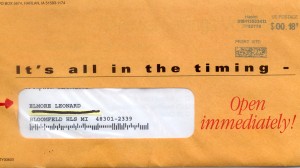 I wonder if Elmore Leonard spends his winters in Detroit. I bet he doesn’t. He writes a lot about Florida.
I have some Elmore Leonard junk mail.
City Primeval: High Noon in Detroit. That’s worth reading.
Maple means 15 Mile. Big Beaver is 16 Mile.
What about Oakland University? Does the university have Bobby Seale barbecue sauce in the cafeteria?
I live only three and a half hours from Berkley, Beverly Hills and Oakland.
—
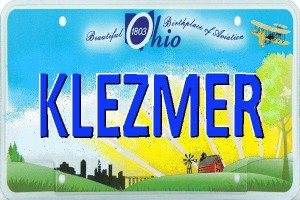 Yiddishe Cup pulls into Motown Sunday. See us at Cong. Beth Shalom, Oak Park, Mich.,
2 p.m., Sept. 9. Open to the public. Concert info here.
September 5, 2012 7 Comments
WHAT’S UP, HANKUS NETSKY?
I see Hankus Netsky, the leader of the Klezmer Conservatory Band, every couple years.
He never remembers my name.
I don’t hold that against him. His best greeting is “How is your Mickey Katz project coming?” (Yiddishe Cup is at times a Mickey Katz cover band.)
I’m flattered. Hankus remembers something about me.
How many musicians does Netsky see in a week? A lot. He teaches at the New England Conservatory, leads a well-known klezmer band, does music projects at the Yiddish Book Center, and plays in a world music group.
I’m Netsky to some people. I don’t know these people but they know me. For example, Oberlin and Cleveland State students attend Yiddishe Cup gigs, looking for term-paper material, and I don’t remember who they are when they call me three months later.
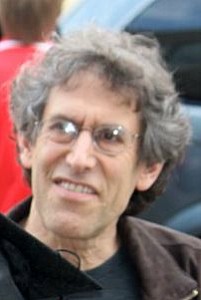
Hankus Netsky
I wonder who says to Netsky: “Sorry, I don’t remember your name.”
Nobody says that to Netsky. Obama doesn’t, Romney doesn’t, Perlman doesn’t. Sapoznik doesn’t.
Netsky, the Great One . . .
—-
Footnotes:
1. Hankus Netsky’s wife is Clara Netsky. Say that. (Don Friedman, Yiddishe Cup’s drummer, concocted this pun.)
2. Ring Lardner Jr. said a well-known person will not remember you unless you’ve been introduced at least five times. (This Lardner Jr. factoid courtesy of Mark Schilling.)
3. Hankus Netsky is a great guy. One of the nicest, smartest, most considerate guys on the klezmer scene. Seriously.
—
SIDE B
Qué pasa, Harvey Pekar? Vos machst du, Michael Wex? . . .
MÁS ACCLAIM
1.
Harvey Pekar’s reputation took off on December 31, 1979, when he got a rave in the national press — The Village Voice — for the first time. But he wasn’t happy.
He told me in 1980, “Movies, interviews — it all falls through. Maybe I’m bowed — my back is short. I’ve got to become more famous. If you’re not a doctor in this town [Cleveland], you’re stuck. The comic-book thing has picked up some, but it doesn’t mean anything in this town. I’d love a groupie to screw, listen to records with, and leave me alone.”
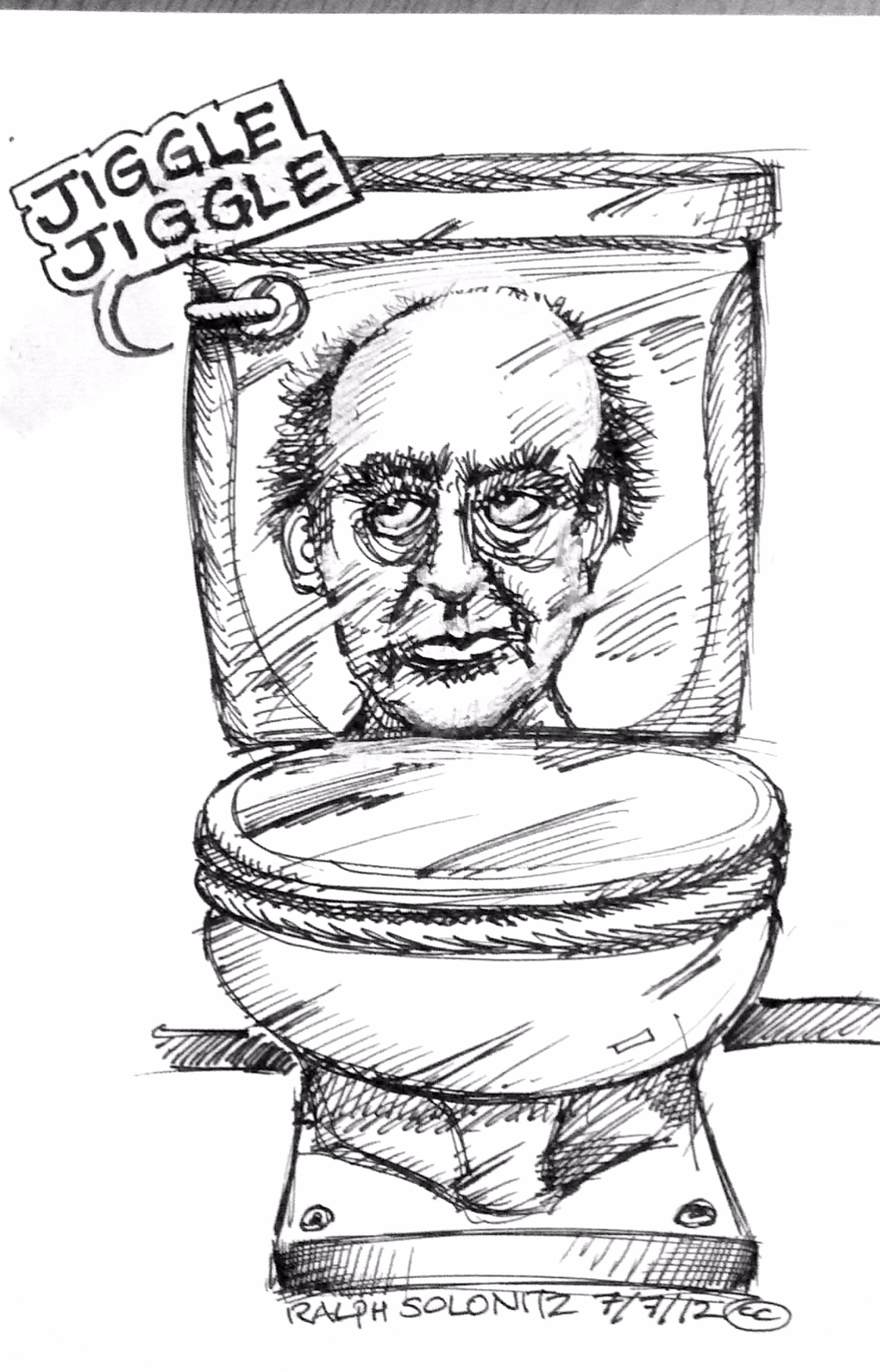 Harvey’s woe-is-me schtick was no schtick; he was down and out. Even after he became famous — after the movie American Splendor — he kvetched a lot: he had money worries, he said; his family scene was precarious; his health was tenuous; and his toilet handle jiggled. Harvey was the guy with the perpetual toothache who thought happiness was not having a toothache. He never ran out of material.
After American Splendor, the movie, Harvey sat on his porch, and fans from all over the world stopped by. He met interesting people without going out.
I went with a foreign fan to Harvey’s porch. The fan and Harvey BS’d for an hour, mostly about Harvey’s upcoming projects.
2.
Michael Wex was on Fresh Air, Terry Gross’s radio show, one time. Pekar was on Terry Gross twice.
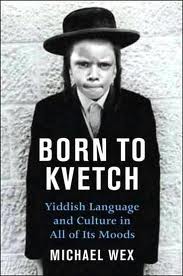 Wex was on the show for his book Born to Kvetch. When Wex’s second book, Just Say Nu, came out, he tried to get on again, but didn’t make the cut.
Wex wrote on his website: “I don’t want a niche, I want an empire!” Funny — and true. In the arts, the more fame the better until you need bodyguards.
3.
I was standing in the prescription pick-up line at CVS with fellow AKs. The man behind me said, “Saul Ludwig, here. You played my daughter’s wedding. Not only that but we also saw you at Chautauqua.”
“I remember you,” I said. “Your daughter is Amy Shulman. I ran into her at a gig in Buffalo.”
“Shuman.”
Give me a break, Saul. Do you know how many weddings I play? Shuman, Shulman, abi gezunt. I can’t even go to CVS anymore.
—
Joke, Saul, joke.
—
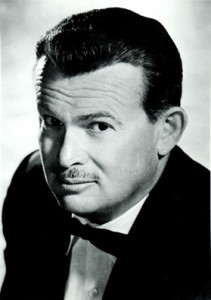
Mickey Katz
I wrote this article, “Mickele: Mickey Katz Lives,” for the Cleveland Jewish News, 7/27/12. More than you want to know about Mickey Katz, probably.
Yiddshe Cup performs a tribute to Mickey Katz 7 p.m. Thurs., Aug. 9, at Cain Park, Alma Theater, Cleveland Hts.
Tix: www.cainpark.com, 216-371-3000, or 800-745-3000.
$20-22 advance. $23-25 day of show. Discount for seniors and students.
August 1, 2012 4 Comments
MY FORMER IDENTITY
When I got rid of my LP record abums, my friend Carl said, “How can you do that?”
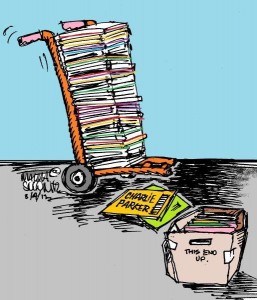
The LPs were heavy, for one thing. And I hadn’t listened to them in 20 years. “Carl, in 10 years I might not be able to physically pitch them, ” I said. “I’ll be pointing at each one from my La-Z-Boy and making my kids choose between Bob Dylan and Charlie Parker. So I’m doing it now for my kids’ sake.”
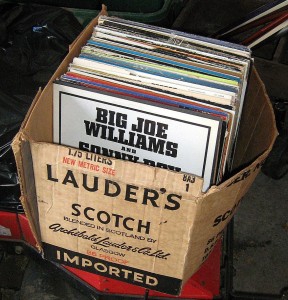
I could have put my records on the treelawn (Cleveland-
speak for the grass strip by the curb). I could have taken the LPs to a record store. Or a record store could come to me.
A record store came to me. Pete the Record Guy showed up at my house.
 Just prior to Pete, Carl took five LPs for a wall montage. He liked Coltrane Plays the Blues, Volunteers by Jefferson Airplane, and Archie Shlepp’s Four for Trane — all good cover art. Carl, a roots-music maven, said I was in the top 5 percent of respectable record collections.
My record collection was my former identity. It was my Facebook persona, circa 1975.
I found a receipt in a Stuff Smith Black Violin album — $1.50 from Mole’s. Where was Mole’s? I don’t remember. [It was on Coventry Road in Cleveland Heights.]
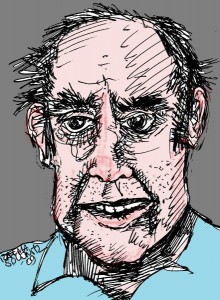
Harvey Pekar
Harvey Pekar used to rifle through my albums. The only album he ever wanted was my Charlie Parker Memorial Album, Vogue Records, England, 1956. I didn’t sell it to Harvey. I figured, If Pekar wants the record that badly, it must be worth something.
I checked on the Charlie Parker Memorial on the Internet. Today it’s worth £5.40 to an Englishman on eBay. That’s about $9. Nothing. Pekar was always into small numbers.
My kids didn’t want my albums.
I wanted to play Lenny Bruce’s “Lima, Ohio” bit (from The Best of Lenny Bruce) for Carl, but I didn’t have a record player handy. Carl said, “It’s probably on YouTube.”
Right. That’s why I got rid of my records.
Pete the Record Guy went through my albums three times. Adiós Aretha Live at the Fillmore West, John Handy’s Carnival, Paul Butterfield . . .
Let it go.
Three-hundred dollars from Pete for 100 records. Not bad. Pete didn’t care about the condition of the records. Pete said young kids –- his main customers — “won’t buy the reissue LPs, they want the originals, like yours.”
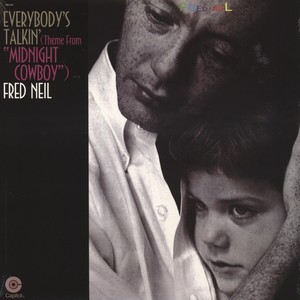 I said, “What jumped out at you? Is there any album worth 90 percent of what you paid me?”
He said, “I like your two Fred Neil’s, Everybody’s Talkin’ and Sessions. You don’t see those often.”
“Let me take a photo. Don’t worry, Pete, I’m not taking the records back.”
—-
SIDE B
(This flip side is a little something extra for readers arriving on the A train from New York Times Square. Northerners, let’s trash the Sun Belt . . .)
ATLANTA: NOT SO HOT
Atlanta is not far enough south for some Atlantans. Right next to the Atlanta airport is a billboard “Beach Bummed?” Meaning, go to Florida.
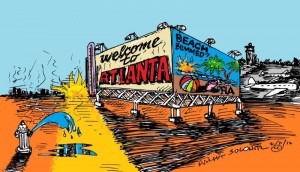
Atlanta isn’t very good for sunbathing unless you want to tan your left elbow in traffic for several hours.
I was at Atlanta airport, going through nine time zones to get to my gate. The TSA clerk, glancing at my ticket, said, “So you’re going back to beautiful Cleveland?”
Yes, sir, and it’s a lot better than Atlanta. (I didn’t say anything.) Cleveland is not Paris — or Pittsburgh, for that matter — but it’s a step up from a Southern-sprawl traffic crawl.
I’m going to Atlanta this month for a family bat mitzvah, and I have a summer gig there with Yiddishe Cup. I’ve been to the Coke Museum twice. Is there a rum-and-Coke museum in Atlanta? If so, where?
—
Atlanta relatives, nothing personal!
—
My best writing is “The Landlord’s Tale” in the latest City Journal. Please check it out. Must read long amusing essay about real estate now!
March 7, 2012 9 Comments
BUGGED
Why do nursing-home administrators request 100-percent peppy music from performers? Some residents want to hear contemplative tunes.
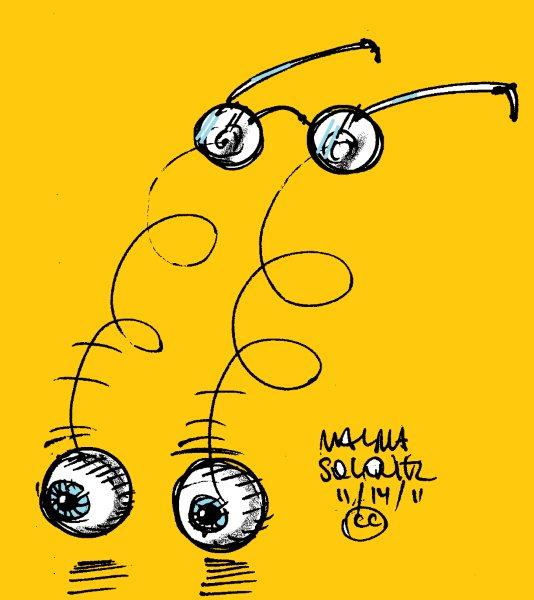 Why do eyeglass-frame adjusters have so much power over us? Did they all get PhDs? From where? I.U.?
How come newspaper columnists don’t write about pet peeves anymore? That’s annoying.
My wife took the electric toothbrush to Columbus, Ohio, on a business trip. The electric toothbrush — and the seltzer machine and Bose radio — are permanent attachments to the dwelling, Alice.
Why does Zagara’s grocery in Cleveland Heights sell only 12-packs of shabbat candles and not the 72-candle jumbo box? Zagara’s Jewish Lites.
What about those phone solicitors from yours kids’ colleges who ask for money. What are you supposed to say? “Here’s another $50. No problem.”
Why do “highly sensitive” people insist on telling you what bothers them? That’s irritating.
When your computer crashes, why do you feel like your right hand fell off? Why can’t you feel like a mosquito bit your ankle.
Who is nostalgic for mimeo machines? Somebody should be.
Why do “sophisticated” Clevelanders brag about not reading the Plain Dealer? They say, “I’ve lived in Cleveland for 20 years and never subscribed to the PD. I read the New York Times. ” Go home.
People who grow vegetables always serve arugula. Why don’t they grow dates or figs?
Why do concertgoers at the Cleveland Orchestra applaud maniacally after every single piece? The listeners nap for 54 minutes (Mahler Symphony #1), then give the conductor three curtain calls. Applaud this!
If you want to talk about cars, first ask: “Do you want to talk about cars with me?” Same goes for sports, TV shows and politics.
Which is preferable: a) “He passed away.” or b) “He passed.” Answer: “He passed away.” Best answer: c) “He died.”
Who was the curmudgeon — Harvey Pekar or Andy Rooney? Coin toss.
Don’t complain about lousy cell phone service and long lines at the post office. That’s modern life. You wouldn’t get upset by a house sign that said the smith’s, would you?
November 23, 2011 5 Comments
JUST SAY NO TO RANDOMIZATION
The first three digits in your Social Security number mean something. For instance, 545-573 and 602-626 indicate you are a native Californian. 268-302, an Ohioan.
That’s history. Effective Saturday, newly issued Social Security numbers (SSNs) will have no geographical significance. The “Social Security Number Randomization” policy hits.
New Gavins, Emmas and Destinys will get random SSNs.
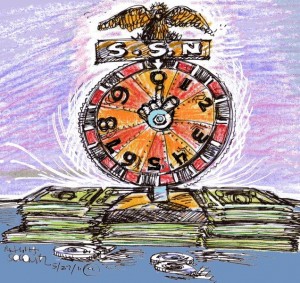
I read about the randomization policy in the Social Security Administration/IRS quarterly newsletter to employers.
I look at Social Security numbers a lot because I’m a landlord. One apartment applicant wrote his SSN as 900-. There are no 900-999s. I turned him down on the spot. Likewise, there are no 000s-. And I don’t rent to 666-; that’s the devil’s number, and the Social Security Administration (SSA) doesn’t stock it.
The SSA website says, “If your [SSN] concerns are firmly rooted in your religious beliefs or cultural traditions, Social Security will review your request.”
The new randomization policy will extend the number of available SSNs. There are 435 million unused numbers. Dead people’s numbers go to the grave with them.
What about a vanity SSN? Are the feds thinking of that?
They should. Parents might pay $100 for a snazzy SSN — say, a 999-. Something that would stand out on Baby Emma’s college application 17 years from now.
Just say no to randomization.
Baby Emma is not a random number. And Gavin is an Ohioan — a proud Buckeye. Destiny, she is a California girl (602-).
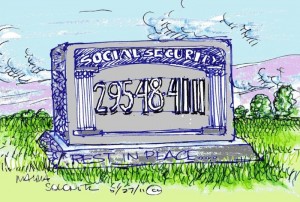
Joe Buckeye
—-
Due to a computer glitch, this post (“Just Say No to Randomization”) didn’t go up on Wednesday June 22. It went up today, Saturday June 25.
—-
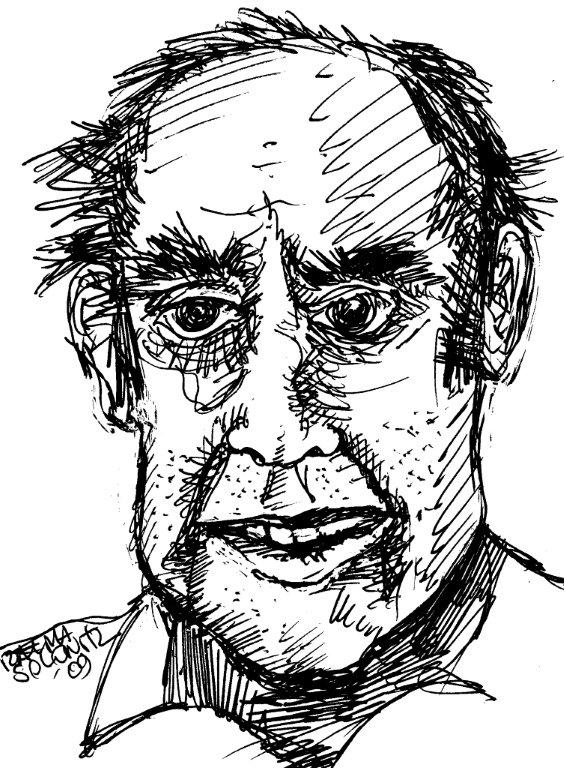 Here’s an op-ed I wrote for the Cleveland Plain Dealer last Sunday. “Harvey Pekar’s Hollywood Hustle.”
June 25, 2011 3 Comments
HOW HARVEY PEKAR DIED
Comic book writer Harvey Pekar died from an “accidental” overdose of anti-depressants, the Cuyahoga (Cleveland) County coroner ruled.
Powell Caesar, the coroner’s spokesman, said Pekar died from “acute intoxication via ingesting fluoxetine [Prozac] and bupropion [Wellbutrin].”
Powell continued, “The death was accidental. Ingestion was accidental. This case is closed.”
The autopsy and toxicology analyses were completed last week.
Harvey died July 12 in his bedroom in Cleveland Heights.
I contacted the coroner’s office (and talked to Powell Caesar) because I hadn’t heard, or read, how Harvey died.
October 19, 2010 3 Comments
MAN AND SUPERMAN
At the Harvey Pekar (urn) Benefit, a hipster with shoulder-length dreadlocks said, “I wrote a book about my sex life. Three-hundred forty pages.”
I asked, “You going to do another one?”
“No, I don’t think people are that interested.”
The Pekar benefit had characters, especially hippie dinosaur characters, myself included. (Another species of dinosaurs — old ethnics — gathered three blocks down at the Slovenian Workmen’s Home to hear Bobby Kravos’ polka band.) The Pekar benefit was at the Beachland Ballroom, formerly the Croatian Liberty Home, Collinwood.
Ex-Cleveland Heights Mayor Alan “Popo” Rapoport, age 61 — and 23 years out of politics — was back on the scene. He danced a hora to Yiddishe Cup. He was running for the new county council seat.
After the benefit, my wife, Alice, and I ate with Popo at a nearby cafe. He said he was in Collinwood, in part, to put up campaign yard signs at street intersections. He did the sign installations around midnight so he wouldn’t get a ticket for littering.
I asked Popo what he had been up to for the past two decades.
“Real estate law and probate,” he said. “Sometimes called graves and ground.”
Alice said, “You should write a blog, ‘Graves and Ground.'”
Popo said the Harvey Pekar toxicology report could take six weeks or so to come back from the coroner’s office.
At the Beachland Ballroom bar earlier, Harvey’s wife, Joyce Brabner, had told me, “Harvey had worse [prostate] cancer than I let on.”
When I offered Joyce my condolences, she said, “Some people get that confused and say ‘congratulations.'”
“That too,” I said.
I wanted to ask: “How can you suddenly croak of cancer in your sleep?” (Harvey had died quickly at home in his bedroom.) Instead I said, “Is there some Latin word for how he died?”
Joyce said no. Then she left the bar area. She knew many people in the Beachland, including a free-lance photographer on assignment from the New York Times.
The New York Times had run an article “The Upbeat Final Days and Busy Future of Harvey Pekar” several weeks earlier. In the piece, a Cleveland illustrator had said Harvey was chipper the day before he died. Joyce wanted her side of the story out. Harvey, upbeat? Not likely.
Would The Times actually run three stories on Pekar? (1.) Half-page obit. Done. (2.) Chipper Harvey story. Done. And now Joyce’s take? Joyce was the PR wizard. Could happen.
The angle: How could Pekar not have enough money to bury himself? The cheapest guy who ever lived! He lectured for decent fees; had a piece — albeit small — of a Hollywood movie; and collected Social Security and government pensions.
Joyce said the gobierno had cut off Harvey’s checks, pending determination of the cause of death. Harvey died at 70 and left no will.
Seventy is the new 60 for dying. Seventy is a raw deal. You’re supposed to reach 80 now, al minimo. My dad died at 69 in 1986; very few people back then considered that unusual.
Eighty-plus or bust. Alfred Lerner, the former billionaire chairman of MBNA and owner of the Cleveland Browns, died at 68 of brain cancer a few years ago. That was news on two fronts: (1.) The man died so young. (2.) The man’s mega-money couldn’t get him another decade.
The Beachland Ballroom owner talked about erecting a statue of Harvey at Lake View Cemetery.
Joyce said, “This town can’t raise enough money for a statue of Superman, let alone one for Harvey.”
Paging Harvey Pekar. Your burial urn tsuris cries out for a new episode of American Splendor.
—-
Footnotes:
1. There was talk of putting up a Superman statue in Glenville, the Cleveland neighborhood where two high school boys created Superman in the 1930s.
2. The sentence “Your burial urn tsuris cries out for a new
episode . . .” is stolen, in large part, from writer/critic Mark Schilling.
—-
2 of 2 posts for 8/11/10
August 11, 2010 No Comments
RETURN OF THE MAGGIES
Maggies were linoleum salesmen/hustlers in Cleveland.
Harvey Pekar wrote a comic strip about them several decades ago. I didn’t hear the word maggies again until last week, when my cousin Danny Seiger, 78, expounded at shabbes dinner on the maggies of Kinsman Road. At first I had no idea what Danny was talking about. Neither did my wife. She said, “Magistrates?” And I said, “Magi?” (I hadn’t remembered the Pekar comic strip.)
“Magi!” Danny laughed. “Magi? That would be Yoshke’s boys!” [Jesus’ boys.]
“The maggies carried thick samples of linoleum that looked like Venetian marble,” Danny said. “They sold nine-by-twelve sheets for fifteen dollars. Nobody had fifteen dollars back then, so the maggies took five bucks on installment, and came back with a roll of tissue-paper. They could carry it upstairs real easy. It weighed three pounds. The maggies laid the tissue-paper linoleum on your kitchen floor, collected the five bucks, and never came back.”
Danny grew up in his parents’ deli, Seiger’s Restaurant on Kinsman Road, and knew something about conmen, kibitzers, bookies, contractors and maggies. It was like an Eskimo knowing about snow. [Kibitzers are meddlesome observers.]
The maggies sold more than linoleum, Danny said. They sold ties at barbershops, socks at saloons. Each maggie had a territory and a product line. “One maggie stood by the streetcar stop and ran up to women with nice lemons,” Danny said. “The maggie held up a few lemons and said, ‘Two for a nickel, three for a dime.’ The woman gave him the dime and hopped on the streetcar.”
***
Relevant: Yiddishe Cup plays the Harvey Pekar (urn) Benefit this Saturday night at the Beachland Ballroom, Cleveland. If enough funds are raised, Harvey’s urn goes next to Eliot Ness’ grave at Lake View Cemetery.
I Googled “Maggies” after my cousin Danny left. Maggies, an Irish music group, popped up. Then I tried “Maggies + Pekar.” I was thinking about Pekar because of the Beachland gig, and something about “Maggies + Pekar” jogged my memory . . .
Michigan State University Libraries,
Comic Art Collection.
“The Maggies: Oral History”/story by Harvey Pekar;
art by R. Crumb. 2 p. in American Splendor, no. 7 (1982).
I phoned Danny Seiger and read the Pekar story to him. I wanted to know if Turk’s deli — where the maggies hung out in Harvey’s comic — was the same place as Seiger’s deli. Danny said, “Turk’s was at One-hundred Seventeenth. We were at One-hundred Eighteenth.”
I said, “There were two delis right next to each other? How many delis were there in Cleveland?”
“There were seven on Kinsman, and twenty-eight in Cleveland in the 1930s,” Danny said.
“What about Zulu Goldberg and his brothers — the guys in the comic who sold linoleum in bulk to the maggies?” I asked. “Was Zulu a real person?”
“That’s Goldbergs from Ohio Savings,” Danny said. “They did business.”
***
Maggies, the word, comes from Magnoleum, a linoleum brand, Danny said. Pekar’s comic-strip character — an unnamed old man — said maggies got their name from calling female customers Maggie.
Harold Ticktin, 83, a former Kinsman cowboy and street-corner historian, might be able to settle this.
Answer the phone, Harold!
. . . Harold says, “I have no idea what maggies are. Never heard of it. Now there was this Italian, Tom Black, who sold sweaters at One-hundred Forty-second and Kinsman. You tried the sweaters on in the bathroom at the gas station. The sweaters looked real good in front but went up your back like a window shade.”
—-
Yiddishe Cup plays 8-9 p.m. this Sat. (Aug. 7) at the Harvey Pekar (urn) Benefit at the Beachland Ballroom, Cleveland.
August 4, 2010 2 Comments
HARVEY PEKAR WASN’T THAT FUNNY
Harvey Pekar wasn’t that funny in real life. He was a campeón del mundo bitch-moaner. He would drey you with pedantic lectures on, say, an avant-garde jazz musician or a neglected writer such as George Gissing. Harvey threw in gobs of “you know’s,” connectors that allowed him to talk for a half-hour nonstop and still retain membership in the Youse Guys Club. The lectures were always about Harvey, with the occasional aside about the neglected artist, who was also Harvey.
When Harvey edited his work for his comic books, he distilled a year’s worth of harangues and keen journalistic observation into a few thousand words. The comic book — the insights, the dead-on dialogue and the self-deprecating humor — was the opposite of his rambles.
Ray Dobbins (a.k.a. Jim Flannigan), the author of Don the Burp and Other Stories, was an ex-Clevelander in New York, who lived in the East Village near a Village Voice critic. Dobbins showed Harvey’s early comic books to critic Robert Christgau and his wife, Carola Dibbell, and she wrote up Harvey for the Voice, Dec. 31, 1979.
Onward.
Through the ensuing acclaim and fame, Harvey was, still, the Kinsman Road boy who unfortunately attended Shaker Heights High. That move — from proste Kinsman to fancy-schmancy Shaker of the 1950s — contributed mightily to Harvey’s me-against-the-world attitude. Read about it. It’s in his comic books.
At my first son’s bris in 1981, Harvey gravitated toward the mohel, an Orthodox rabbi.
Harvey told me he was going to write about the bris. Something about the mohel raising his arms and saying, “Golden hands!”
Pekar saw things others missed. And he got it down on paper.
—-
[“Drey” is turn/pester. “Proste” is common/boorish.]
[More on Harvey at “Where is My Harvey Pekar Bobblehead?”, a Klezmer Guy post from 2/3/10.]
—
2 of 2 posts for 7/14/10
—
See “Driving Mr. Klezmer” 7 p.m. Thurs., July 29, at Cain Park, Alma Theater, Cleveland Heights. $20 in advance. $23 at the door. Call 216-371-3000 or visit www.cainpark.com.
“Driving Mr. Klezmer” is a clutch-popping trip through the states of klezmer, pop, Tin Pan Alley and spoken word. The ride: a Ford Tsuris.
The show is a nudnik/beatnik mash-up of music and comedy. Bert Stratton is on clarinet and spoken word (i.e., this blog). Alan Douglass, the chauffeur, is on vocals and keyboards.
—
July 14, 2010 4 Comments
