
ROLLING THE DICE
My tennis partner, Ivan, wanted to add a drive-thru window at his frozen custard shop. The addition was a big deal; there were environmental remediation concerns. The drive-thru would be on the site of a former auto repair place. Nobody wants gasoline on their ice cream cone. Ivan is 77. The drive-thru would cost hundreds of thousands. What did he need this aggravation for?
He did it. You’ve to respect an old man still taking risks like that. Or maybe Ivan is crazy.
I’m not a big risk taker. For instance, 12 years ago I freaked out about buying a medical office building in Solon, Ohio. I was 63 and didn’t really need more “action.” But my friend Carl — a fellow real estate investor — said, “You’re not dead yet.” And my wife added, “It would be a good challenge, and you’ll learn something.”
Or I could have studied Spanish, or maybe art history, at Cleveland State University. The university sponsors tuition-free classes for seniors 60 and over. The medical office building would cost more than a million dollars, and if it flopped, I wouldn’t be too happy. Carl said, “If it flops, you’ll be OK. You’ll live with it.”
I lived with it.
Do something — that’s my wife’s mantra. She’s a former gym teacher. Still, when I’m spending a lot of money, I get nervous.
I wrote an email to my investment partner: “I’m out. I don’t need it.” I didn’t relish such a roller coaster ride in middle age. I didn’t need more buildings. I met my partner for breakfast the next morning and bailed. He said, “If you’re that anxious, yes, bail.”
I slept on it again — actually, didn’t sleep — and changed my mind. The deal happened. Then, three years later, I sold the property right before the office building crash. I made money. Win some. (I’m not going to tell you about my “lose some”s.)
I have three file cabinets in my home office. That’s probably more than you have. I like paper. Yes, I have QuickBooks Pro and Excel spreadsheets, but I’m more old school than new school. (My daughter runs a 100-person company and doesn’t even own a pen, she says.)
A 24-year-old employee once said to me, “The whole history of 20th-century Cleveland real estate is in this office.” Like the other day, I threw out some 1994 employee W-2s and a boiler manual from 1990. I also collect notes from my father, who died in 1986. He started the family real estate biz. He used to jot notes on 8-column green accounting pads. I study these accounting pad marginalia for insights. I’m not quite sure what I learn . . . “Light the incinerator from the top floor down, so the refuse burns down.” Incinerators were banned around 1974. “Blow down the boilers every week.”
I should have been a historian.
I don’t dwell on the past all day long, but how about half hour a day? I recommend it, particularly if you’re 60 and up.
A high school friend, now living in New York, recently wrote me a super-curt email: “Not sure I want to meet up. No nostalgia here.” That was the entire email. He and I and other high school friends were supposed to meet up in Cleveland. My old buddies were from out of town. That’s the thing with a family business; I’m stuck here. We didn’t visit our old stomping grounds. We went to the Cleveland Museum of Art — always a safe, quality choice.
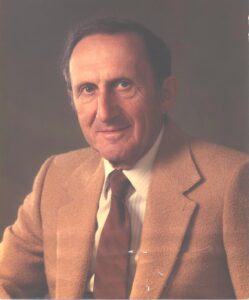
Toby Stratton, 1985 — a year before he died.
A year before my father died, I interviewed him on videotape. Part of my history-buff thing. My dad got riled when I asked him, “Do you ever think about your mother?” I asked that because my dad rarely talked about the good old days, in central Cleveland, with his dirt-poor Eastern European Jewish immigrant parents. My dad said, “Son, I think about my mother every day!” He just didn’t feel like announcing his affection daily.
My dad was good about moving on. He was always reinventing himself: chemist, stockbroker, office manager, cosmetics salesman, real estate investor. I’m not that great at it — moving on.
I saved some of my father’s personal financial statements. He inflated car values and listed stocks he didn’t own. He liked to fudge financial statements. These slightly cooked documents helped him get bank mortgages for his investment properties. My dad claimed he had $17,000 total in Emerson Electric GTE and GM stocks. And he claimed he had life insurance with a cash value of $78,000. Nope.
My dad loved leverage. He bought his first building with only 8 percent down. I don’t know how he slept at night. Come to think of it, he didn’t sleep much. He was often cranky.
I don’t roll the dice as easily. I’d like to own an old Burroughs adding machine — one that makes a lot of noise and has a clanky lever like a slot machine. Take me back.
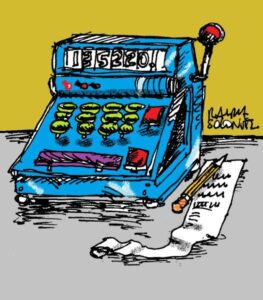
Sorry, I’m losing it. I’ve been stuck in this real estate office, above my garage, for 32 years. Before that, I was in a basement for 12 years. Before that, a third-floor attic.
I move slowly.
Change? Let me think about it.
—
[This essay first appeared in Phi Kappa Phi Forum magazine, Spring 2026.]

1 comment
77 is the new 22!
Leave a Comment