
TWO ANN ARBOR BLUES BOYS
Mark Schilling wrote this guest blog post:
Bert and I first met at Mich House (Michigan Cooperative House) in the fall of 1969. He was then a sophomore and I was a junior at the University of Michigan. We were both natives of Ohio or, as OSU football fans would say, “traitors.” I had lived in Barberton, Ohio, from grades one to eight, Bert in Cleveland from day one, so we shared memories of local TV shows and sports teams.
But our first and, for a while, foremost bond was musical. Bert, who had been a founder of the Ann Arbor Blues Festival, pronounced my record collection “cool,” especially for American Blues Festival, a rare LP of performances by Sonny Boy Williamson, Memphis Slim and other blues artists recorded in Bremen, Germany, in 1963. I’d found it in a cut-out bin in Dayton, Ohio.
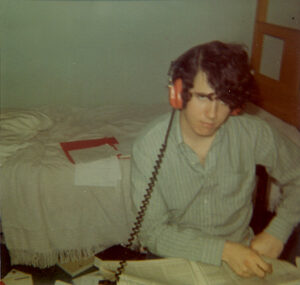
Mark Schilling, 1970, Mich House
We listened to this and other records in Bert’s second-floor room, which he shared with John Cochrane, a laid-back Michigander who kept his hair short due to his service in the National Guard. We soon branched out to jazz, from Louis Armstrong and Duke Ellington to Charlie “Bird” Parker, Dizzy Gillespie and other titans of bop.
A few ancient (i.e., over 30) grad students shared reminiscences about Dave Brubeck and other jazz favorites of their youth when they heard us spinning jazz discs (mostly borrowed from the Ann Arbor Public Library) on the record player in the living room, but other undergrads living or boarding at Mich House were rock fans so we became a Jazz Appreciation Society of two.
John, however, joined Bert and me on an expedition to Baker’s Keyboard Lounge, a jazz club in Detroit still in operation, to hear a “battle of the saxes” between Sonny Stitt and Gene Ammons, who had just finished a seven-year prison sentence for a narcotics possession charge. The place was packed but we were the only white guys in sight, save for the club owner, Clarence Baker, who was at first thrilled to see college kids in his joint, but became peeved when we didn’t order drinks for the second set. (I broke down and got another beer. Not sure about Bert and John.)
The music was great, prompting us to seek out more live jazz (if minus John). We caught a Duke Ellington concert at Hill Auditorium, sneaking down from the cheap seats to empty ones near the stage, as gray-haired audience members shot us looks both amused and surprised.
We also saw Rahsaan Roland Kirk in Detroit, where he played multiple horns simultaneously, blowing many minds, and Miles Davis at Hill Auditorium, where he and his quintet played tunes from his new album Bitches Brew. (Bert, who was sitting with me about 20 rows back, walked up to the stage and asked Miles something as he was preparing to play, which given Miles’ fearsome public image I thought took balls of brass.)
Then writing about music for the Michigan Daily student paper, Bert also caught folkies like Buffy Sainte Marie and Michael Cooney and blues greats like Mississippi Fred McDowell and Big Mama Thornton with me tagging along.
We also went to the John Sinclair Freedom Rally, a 1971 concert for poet/activist John Sinclair, who was then serving a 10-year prison sentence for selling two joints to an undercover agent. John Lennon showed up with a tune he had specially composed for the occasion, together with Yoko Ono, Phil Ochs, Bob Seger, Stevie Wonder, Commander Cody and others. Sinclair was sprung shortly thereafter.
Bert and I also ventured to the Cincinnati Jazz Festival at Riverfront Stadium in July 1971 to catch Billy Eckstine, Chuck Berry, Dizzy Gillespie, Herbie Mann, Lee Morgan, Rahsaan Roland Kirk (again) and Roberta Flack. A group of Black ladies sitting near us swooned over Billy but laughed at Chuck. His duck walk wasn’t their thing.
Along with all this concert- and club-going, Bert was playing the harmonica and the sax – the later to the annoyance of the guy across the hall, a music grad student from Texas who had the only single room in the co-op, which he wasn’t about to give up because of Bert. And Bert wasn’t about to stop playing in his room since he had nowhere else to practice. So the grad student, Morris, and Bert would exchange words while John buried his head in the blankets of his upper bunk bed, and I studied cracks on the wall.
Morris was not a jazz fan. And for Bert, klezmer was in the future.
—
Mark Schilling moved to Japan 51 years ago. He is the preeminent English-language writer on contemporary Japanese cinema. Mark was the “best man” at Bert’s wedding.

0 comments
Kick things off by filling out the form below.
Leave a Comment