
OLD GUYS
The phone number at AAA Window Shade Co. was 221-3700. The proprietor, Joe Villoni, started there at 13, and was 87 when he pulled the last shade down. Seventy-four years: same job, same location.
He quit in 2003 because nobody was buying window shades anymore. Everybody was into $5 mini-blinds at Home Depot. My father,Toby, and I had kept Joe’s rent low because Joe never asked for anything.
The store’s wood floor had a grooved path circumnavigating the huge window shade—making machine. That apparatus, and possibly the whole store, belonged in the Henry Ford Museum.
I always liked Joe — and the other old-guy tenants. I was just a baby, a pisher (pisser/youngster), to these guys. Another old tenant, Jim English, gave me a metal Phillies cigar box full of screws. I appreciated the cigar box more than the screws. I was in my twenties and collected anything older than myself.
An old custodian, Jeanne Saunders, left me several novel manuscripts when she died. She had one lung, a great disposition, and a tough life; she should have written her life story and gone easier on the long, lanky cowboys and gladiators.
Another old custodian, Mary Kubichar, produced a concert for Yiddishe Cup. It was at the Beck Center for the Performing Arts on the West Side. That was the first — and last — West Side Yiddishe Cup concert. (West Side means “not a lot of Jews.”)
Mary was from western P.A. (You need to say each letter: P. A.) She never married. After retiring from Higbee’s department store, she became a super volunteer at her church and the Beck arts center. So when she told the arts center to hire Yiddishe Cup, they owed her. The concert turned into an appreciation party for Mary. (She died the next year.) Even the publisher of the Cleveland Plain Dealer showed up. It was a very big deal. We played a couple Slovak pieces for Mary.
—-
1 of 2 posts for 10/28/09. Please see post below too.
October 28, 2009 4 Comments
SKIPPERS
I knew a building inspector who could smell rats. That’s what he claimed. He didn’t have to see the droppings.
I knew a custodian who could jimmy almost any apartment door with a credit card.
My dubious talent is figuring if a tenant has skipped out or not.
First, the tenant hasn’t paid his rent. That’s a given. I knock loudly on the tenant’s door. No answer.
I yell “maintenance” a couple times, and bring out the master key. I yell “maintenance” a third time, and I step into the apartment.
A couch, a bed . . . always. Skippers leave behind the heavy stuff. TVs too. Everyone upgrades his TV on move-out.
Some small items stay behind: beer bottles, pennies, unopened bills. Usually enough to fill three or four garbage bags.
The stove: cooked.
The refrigerator: always missing a couple crucial shelves. Why?
Underwear and socks . . . gone.
No socks, no tenant. The guy definitely skipped.
Some of his clothes are jumbled on the closet floor. Decent stuff too. Skippers are usually too anti-social to take items to Goodwill.
I found a tux left behind. The guy was 6-4. I had the pant legs shortened. (He wasn’t a skipper. He was a dead man. And his place was clean.)
I enjoy wrecked apartments. So would most people, I bet. It’s like staring at a car crash. Most of my building managers like trashed apts. (Some managers make extra money on the cleanups.) One manager would gleefully phone me with on-the-scene reporting: “It looks like a cyclone went through here crossways!”
The rat hole tour isn’t for everybody. One young manager passed on a good show. “I’m creeped out,” she said, standing in the apartment corridor, while I went into the suite.
What’s to be creeped out by a few bottles of beers, cat urine and cigarette butts?
Afterward, I sometimes phone the skipper to make sure he’s definitely gone. I say, “You out yet?” No lectures about housekeeping.
Nobody likes to be criticized on his cleaning skills. And he might come back for his DJ magazines — and me.
—-
2 of 2 posts for 10/28/09
October 28, 2009 No Comments
FISHY
1. JEWISH FORK-LORE
Musician Mickey Katz called chocolate phosphates “Jew beers.” He drank them at Solomon’s on E. 105th Street.
I drank mine at Solomon’s at the Cedar Center shopping strip, where Solomon’s moved to.
For some Semitic semantic reason, goys occasionally called Cedar Center the Gaza Strip. Now it kind of is. The north side of Cedar Center is concrete chunks and gravel heaps. A real estate developer knocked down the 1950s-era plaza and plans to redevelop. Who knows when.
Solomon’s was my family’s deli of choice. My father, Toby, was a “deli Jew.” In the Jewish world, that’s usually a putdown, meaning the person knows more about corned beef than Rashi. Toby’s favorite food was a “good piece of rye bread.”
Toby, a phosphate fan, probably didn’t drink more than a dozen real beers his whole life. He should have. In his retirement, when he drank booze he smiled a lot more. A bit shiker at one party, Toby teed off on a watermelon fruit bowl with a golf club. That stuck with me. [Shiker is drunk.]
Toby grew up in a deli. His mother had a candy store/ deli at E. 118 Street and Kinsman Road. She sold it to her half-brother when he came over from the Old Country. Something fishy about that deal — something involving the half-brother’s wife. My grandmother went from candy store/deli owner to simply candy store owner. Not a lateral move.
At the Gaza Strip, there was also Corky & Lenny’s. (Still around — four miles east.) A couple small Jews hung out in the rear booth at Corky’s. One was Harvey, who did collections for a major landlord. (Major, to me, means more than 1,000 units.) I knew Harvey from junior high.
He sued my mother. My mother, for health reasons, moved from her Beachwood apartment after 27 years into an assisted living facility. She had a couple months left on her lease. Harvey, who represented the major landlord, went after her. Harvey’s boss, by the way, loved my band. So what. My mother was collectable.
Freelance journalist David Sax just wrotea book about the decline of delis. Here’s something for the second edition, David: Delis went downhill when they added TVs. Now you have to watch the Browns while you eat.
I was deli-famous. At Jack’s Delion Green Road, I had a thank-you note up in the entrance. My letter was about the terrific tray for my firstborn’s bris. Fatherhood was about buying huge quantities of smoked fish. What a blast. (I ordered the exact same tray for my daughter’s naming.)
I complimented Jack’s Deli on its fish, which my Aunt Bernice, The Maven, also liked. I mentioned “The Maven’s seal of approval” in my letter. Bernice work for a food broker and knew food.
My letter was up for a couple years.
—
(Acknowledgment to Henry Sapoznik for “fork-lore” in this story’s title.)
***
2. ’DINES
The trend at mass-feed kiddushes (post-service temple chows) is toward Israeli foods: hummus, baba ganoush, Israeli salad.
When you privatize — and don’t invite the whole congregation — you typically add some fish.
All Jews like a good piece of fish: lox, smoked fish, herring, the occasional sardine.
My youngest son recently called from Trader Joe’s in Ann Arbor, Mich., and said, “Don’t get excited, Dad, but do I want the sardines in oil or water?”
“Oil.”
I did get excited. My college kid was finally getting into ’dines.
My mother had given me about eight cans of ’dines when I went off to college. I ate them on Sunday evenings, when the dorm cafeteria was closed. (This was back when sardine cans opened with a key, and the ’dines were Portuguese — not Moroccan like now.) Surprisingly – to me at least – the guys in the dorm wouldn’t share my ’dines. Pizza time.
I liked all kinds of ’dines. Even the monster-size sardines in tomato sauce were OK. Bones, no bones . . . no matter. Cajun sauce, soya oil, olive oil, mustard sauce . . . all good. Four ’dines in a can, two in a can . . . either way.
Anchovies? Also, an excellent choice. Make sure you buy your anchovies in a bottle; they last longer than in cans.
Herring in wine sauce. Beware. Last month Heinen’s supermarket substituted Vita brand for Golden Herring. That was lamentable. Vita is too sugary.
At luncheons, the other Yiddishe Cup musicians don’t seem to appreciate the fish (i.e., the “dairy spread” in kosher parlance) as much as I do. Yes, they like the lox. Lox is apple pie. But the other items (smoked fish excluded) get little play from the band. You should see the mountains of herring left over.
October 21, 2009 17 Comments
THE SHEETS
Sid Beckerman was a living legend of klez clarinet. I followed him around KlezKamp — the music conference — a lot. And you know what, he talked to me.
Big deal?
It was. Sid was paid staff. I was “payer,” as in student/customer/ fawner. Paid staff was hard to corner. They had a lot of demands on their time.
Sid was different than many staffers. Sid had no ego, according to Washington clarinetist Rodney Brooks, another student. “Sid was never a star,” Rodney explained.
Sid was “discovered” by klez revivalists, and made his first record at 70. (He died in 2007 at 88.)
Sid had a handwritten tune book called “the sheets,” as in sheets of paper. Sid’s unarmed guard of “the sheets” was pianist Pete Sokolow, who had transcribed the tunes for Sid.
The most popular tune in the collection was “SB7,” which stood for “Sid Beckerman tune #7.” [Yiddishe Cup plays it on Klezmer Guy. We call it “40A” — the page it’s on in our book. Dave Tarras recorded it as “Di Zilberne Chasene” (The Silver Wedding). Don’t know what page Tarras had it on.]
At KlezKamp I had a strategy for obtaining the sheets from Pete Sokolow. First, I gave Pete an obscure 1938 magazine article about “Bay Mir Bistu Sheyn” (By Me You Look Grand), hoping to get in Pete’s good graces.
Sokolow, stuffing the magazine article in his pocket, said, “The sheets? What sheets? I’m so busy now. I’m working up an arrangement for fifteen people. What did Sid say?”
I hadn’t thought of asking Sid.
So I went to Sid and offered him $20 for the sheets. Sid said, “For what? What transcriptions?”
Interestingly, all the clarinetists from D.C. knew the SB tunes. So I badgered Rodney from D.C. some more. I hocked him. He had learned most of his freylekhs (horas) from the sheets, he told me.
He admitted he had the sheets. “You can xerox them,” he said. “But don’t say you got them from me. Somebody might take umbrage.”
A year later, the sheets came out commercially as the Klezmer Plus! Folio. Everybody could buy them. Sokolow and Sid had just been protecting their investments.
—-
1 of 2 posts for 10/7/09. Please see the post below too.
—-
Yiddishe Cup is at Fairmount Temple, Fri. Oct. 9, and Park Synagogue, Sat. Oct. 10, for Simchat Torah. Cleveland.
October 7, 2009 3 Comments
PISTACHIOS
I had a store tenant who sold gravestones and pistachios. His main window sign read Porter Monuments and a smaller sign was Pistachios.
Not a good sign. He went under.
I had a tenant, the India Food Emporium . . . Indian spices, Indian bread, Indian music. Then came the Marlboros and malt liquor. Went under.
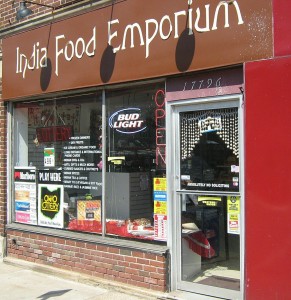
You want a samosa with that 40?
I got a call from a prospective tenant for a headlight removal business. Not a bad concept; headlights are tricky to remove. The caller repeated, “Head lice.” I was still OK with it.
Yiddishe Cup/Kiddush Cup/Klezmer Cup/Some Kind of Cup. Nobody knows our band’s name. All klezmer bands really have the same name: A Klezmer Band.
Sometimes clients hire us after they’ve attended a fun out-of-town wedding with a klezmer band. I ask, “What band?” They say, “A klezmer band.”
There is only one klez band with a name: the Klezmatics.
Yiddishe Cup probably stole a gig from the Klezmatics. An East Coast college promoter booked us because she thought she had heard us on the radio. What radio show was she talking about? She couldn’t remember. We’ve been on Cleveland and Cincinnati public radio. My guess is she heard the Klezmatics on NPR, googled klezmer, and somehow came up with Yiddishe Cup. So she hired us: A Klezmer Band.
—-
2 of 2 posts for 10/7/09
October 7, 2009 2 Comments
THE AGONY STICK
My real estate job is pretty easy physically. I just boss custodians and repairmen around and do paperwork: pay taxes, pay cockroach killers, and argue about security deposit refunds. The only physical part is climbing the stairs and going on roofs. None of my buildings has elevators.
Playing the clarinet . . . that can injure you. You know where? The right thumb. The right thumb holds a disproportionate weight when you’re standing.
I had a pain in my right thumb that lasted 18 months. The pain took a long leisurely trip through my body. Went from my thumb to my shoulders to my neck.
Physical therapists love musicians, particularly violinists, flutists, pianists and clarinetists.
I drove to Cincinnati to see a specialist for clarinet pain. Then I did Alexander Technique, and every other technique short of amputation.
Some clarinet players use a neck strap. I do. At KlezKamp, the music conference, I met a clarinetist who wore a neck strap. He said, “The pain eventually goes away.” That was my mantra for more than a year.
The clarinet is the agony stick. Musicians call it that. Not simply because the clarinet can be painful to play, but because it’s difficult. The fingerings are harder than the sax, and a clarinet has the “break,” the awkward leap from A to B in the middle register. The clarinet squeaks. And the clarinet’s register key raises the note a twelfth, not an octave. This is extremely odd physics. The clarinet’s sound doesn’t typically come out the bell, like on a sax.
You mic a sax by clipping a mic on the bell, but on a clarinet you surround the clarinet with mics like on Wagon Train. I had a mic rig for my clarinet that was so complex and heavy — and cost more than my axe — I gave up on it. Plus, it was hurting my thumb.
I asked a sax player in a big band if he played clarinet. He said, “I have a clarinet.”
—-
1 of 2 posts for 9/30/09. Please see the post below too.
—-
A version of this post will appear in the upcoming (Dec. 2009) issue of The Clarinet, the magazine of the International Clarinet Association, www.clarinet.org.
—-
Apparently some people don’t know there is a comments section to this blog. Click on the “comments” link below the “Tell A Friend” link. If there are few, or no, comments, go to the end of the “Sanctuary” post — two down from here. There are a lot of comments there.
September 30, 2009 8 Comments
GREAT NAMES IN THE RENTAL BIZ
Arvids Jansons. I got a desk when he left.
Argero Vassileros. Nickname: Argie.
Michael Bielemuk. The Professor. He had three rooms with floor-to-ceiling bookshelves.
Maria Malfundido. (Not her real name but close enough.) A kleptomaniac. She stole light bulbs from the hall so we glued the bulbs into the sockets.
Zenon Chaikovsky. Building manager and Ukrainian musician.
Saram Carmichael. A black transvestite who solicited customers from her second floor window. The johns waited at the bus stop outside her window. What is a Saram?
Stan Hershfield. One of the few Jews on the West Side. He was raised in an orphanage and loved the word bubkes (beans), as in: “Stratton, I have bubkes so don’t hondle me about the rent.” [Hondle is haggle.] When Hershfield painted the wood floor in his kitchen, he beamed, “Only the best, Stratton, Benjamin Moore!”
Malfalda Bedrossian. She was never late with her rent. Put that on her tombstone.
Chris Andrews. He made up for his regular name by sleeping in a coffin.
Merjeme Haxhiraj. An Albanian who talked me down $10 on her rent every year.
John “Chip” Stephens. A Chet Baker-like figure — in looks, music and name. He played jazz piano all day and was so good he landed a tenure track job at a university in Missouri.
—-
2 of 2 posts for 9/30/09
September 30, 2009 10 Comments
DEPENDS WHAT YOU MEAN BY “12”
I rent to musicians. I used to give them a break. Like one musician didn’t leave his forwarding address for his security deposit, and I mailed it to him anyhow. He specialized in electronic music. I put “please forward” on the envelope. I never got a thank you. He should have sent an email thank-you at least. He messed it up for the next guitar picker.
I had an older blues guy who screwed me out of a couple months’ rent. A guy in his fifties ought to know that “12-month lease” means 12 months, not six months.
Youngsters — say, 22-to-30 year olds — can’t envision what 12 months means. They think that’s forever. I felt that way when I was in my twenties. These young tenants try to weasel out of their leases. They say they need to move home to help Grandpa, who broke his hip. They need to help him drink beer and watch the Three Stooges! These kids are moving out for one main reason: to shack up with their girl/boyfriend to save on rent.
—-
2 of 2 posts for 9/16/09
September 16, 2009 No Comments
MENTOR HEADHUNT
Everybody needs a mentor. Trouble is I’ve only found semi-mentors.
For music, I’ve basically taught myself. My clarinet teacher showed me the notes and fingerings but he couldn’t improvise. And he never recommended music to listen to. He thought clarinet was like typing.
That was OK with me. I liked typing. I practiced a lot. My mother had me sign a contract not to practice more than an hour a day. And I could not throw my clarinet when I hit a wrong note, particularly at my sister.
Here’s the secret to superior musicianship: Lock yourself in a room for years and hope you were born with a good ear.
That’s why pop musicians sometimes disdain singers. They just sing. They don’t play anything. Many of them never locked themselves in rooms to practice.
***
Vis-a-vis my band, we’ve had some mentors:
(1.) Greg Selker, who reacquainted Cleveland with klezmer in the early 1980s. Greg learned about klezmer from Hankus Netsky at the New England Conservatory in Boston. Greg gave me lessons in 1987.
(2.) Jack Saul (1923-2009), a Jewish record collector. You couldn’t find a seat in his house unless he moved a ton of records for you.
Every time Jack played a record he’d clean it with Windex. No scratches. Smooth-h-h.
He didn’t throw anything out — since day one. He even had a John McGraw baseball card.
A couple years ago I sold my baseball cards — for a few grand — and he said, “Why’d you do that?” I wasn’t looking at them and my kids didn’t want them. My kids didn’t know who Harmon Killebrew was. “Why’d you do that?” Jack repeated, semi-stunned.
The Cleveland Jewish music scene was synonymous with Jack Saul. The Kleveland Klezmorim musicians went to Jack’s house in the early 1980s to record 78s. Those 78s were pristine. When Boston public radio did a radio show in 2000 about clarinetist/parodist Mickey Katz, they came to Jack for clean recordings.
Jack never let a record out of his house. You had to sit there for an hour or two, and have him dub the records onto tape.
The first time I went there, in 1988, I recorded cuts from Music For Happy Occasions, Paul Pincus; Jay Chernow and his Hi-Hat Ensemble; Dukes of Freilachland, Max Epstein; Jewish Wedding Dances, Sam Musiker; Twisting the Freilachs; and Casamiento Judio, Sam Lieberman — a freaking klezmer musician from Latin America!
***
Several months after Jack died, Nathan Tinanoff, the founder of the Judaica Sound Archives at Florida Atlantic University, went into Jack’s basement and came out with 4,000 Jewish LPs in one day. And he didn’t even get to the 78s. By comparison, the National Yiddish Book Center in Amherst, Mass., had 3,000 records, which the center eventually turned over to Florida Atlantic University.
Jack Saul liked Yiddishe Cup a lot. (He also liked Steven Greenman, Lori Cahan-Simon, Cantor Kathyrn Wolfe Sebo — all Cleveland Jewish musicians.) At one community meeting, he said, “We’ve got talent in this town. We don’t have to always run to New York for entertainers.”
That meant a lot to us locals. Go Tribe.
September 9, 2009 1 Comment
KLEZ CZARS
Klezmer bands are often run like dictatorships because klezmer music originated in Eastern Europe — a part of the world notorious for autocrats. Or so hypothesized Walt Mahovlich, the leader of the renowned gypsy-style band Harmonia. Walt is an expert on Eastern Europe. His full name is Waltipedia. Maybe.
Walt used to be in Yiddishe Cup. Technically he still is. He is on a leave of absence, which he requested 13 years ago. Walt likes to keep his options open.
If you run a band as a democracy, you’ll be in total disarray on the bandstand, Walt said. I had a musician who liked to call tunes for me. Drove me nuts. Luckily he moved out of town 19 years ago.
Yiddishe Cup’s keyboard player, Alan Douglass, occasionally requests songs. More often, he requests not to play a certain song. For instance, he does not like playing “balls out” (hard-driving) music during guests’ meals. Sometimes I agree with him, sometimes not. These folks — at bar mitzvah luncheons — are comatose from a three-hour shabbat service followed by a 30-minute kiddush (post-service schmooze). Sometimes they need a bracing shot of high-proof klez.
Some musicians have trouble with bandleaders’ czar-like behavior. My guys — not so much. Yiddishe Cup’s musicians are the best in Cleveland; they get paid the most; and they generally cooperate. If I have a problem with a guy, I’ll talk to him alone, not in front of the others.
Craig Woodson, a veteran drummer, taught me not to air private grievances in public. Craig, too, believed in the benevolent monarch thing. He had worked with a king — Elvis. (Check Craig out in the movie Clambake.)
Craig was Yiddishe Cup’s second drummer. He was good — and in California too often on his own gigs. Yiddishe Cup went through a ton of drummers. Our current drummer, Don Friedman — who has been with us 13 years — knows how to keep time and add tasteful fills. So does our alternate drummer, a yingl (boy) named Diddle.
Diddle, 21, started “playing out” (gigging) when he was 13. I hate that — that start-out-as-young as-Mozart-or-you’re-toast mentality. Diddle’s father hangs around our gigs, kind of like Venus and Serena’s dad.
Cleveland’s jazz king Ernie Krivda played in his dad’s polka band at 13. Clarinetist Ken Peplowski played in a polka band at 13. Joe Lovano started the sax at 5. “At 16 the young Joe Lovano got his driver’s license and no longer needed his father, Big T, to drive
him . . .” blah, blah.
My father was a “Big T” too. Toby. Why didn’t he have a band? Or at least a decent record player.
—-
1 of 2 posts for 9/2/09. Please see post below too.
—-
Yiddishe Cup concert 7:15 p.m. Sun., Sept. 6, Orange Village (Ohio) gazebo.
September 2, 2009 3 Comments
BANK FAULT
My father said job one was getting the rent checks in the bank.
He didn’t even trust the night drop. Had to wait in line.
The worst was when a money order got lost. It might take up to three months to get a replacement.
One time the bank lost 16 rent checks. I used the night drop, and the envelope wedged between the metal chute and the bank’s brick wall. Just got buried in there like a time capsule. I thought I was going nuts . . . Did I forget to make the deposit? Was the deposit in my car somewhere? At home I spent many hours looking through file cabinets and garbage cans for that deposit.
The bank found the deposit three months later, and I said to my tenants, “See, I’m not senile. It was the bank’s fault.” It’s rarely the bank’s fault, so I had to brag.
I wrote the bank manager about my predicament — my embarrassment telling 16 people I had lost their checks. I asked the bank to waive its service fees for a year. I wrote: “My late father, who started the business, began talking to me! . . . ‘You did what? You lost the money?'”
The bank didn’t waive the fees. They did, however, give me $110 to cover tenants’ tracer fees.
—-
2 of 2 posts for 9/2/09
September 2, 2009 No Comments
CALIFORNIA SCHEMING
My dad, Toby, was a big fan of California. He and every other Ohioan in the 1960s.
His cosmetics company, which he started in the basement, was Ovation of California. It was a franchise. The franchisor, based in California, was simply “Ovation.” Toby added the “of California.” Toby sold moisturizers, shampoos, eyebrow pencils, lipsticks and bases.
Bases were war paint for women. My mother, who wore the stuff on sales pitches, looked like a Claymation figure. My parents gave presentations at Cleveland hotels, trying to recruit women to do home sales parties. Better yet, become sub-franchisees. My parents had a carousel-tray slide show with an LP sound track that synched to the slides. Beep.
Ovation went bust. Avon Products was the powerhouse back then.
Californian dreamin’ . . . it’s part of the Midwestern mentality. My family took the station wagon trip to California in the sixties. Our “station wagon” was a 1961 Pontiac Catalina sedan with no A/C. Bobby Vinton’s “Roses Are Red (My Love)” was on the radio.
We wound up in San Francisco — the home of Daniel Ducoff, Yiddishe Cup’s dance leader. I didn’t even know that!
Daniel’s father was a rabbi in Frisco. While I was growing up in standard-issue Ohio, Li’l Danny was being raised in the Haight, or more exactly, three miles from it. To this day, Daniel wears a T-shirt that says “What if the Hokey Pokey really is what it’s all about?” Daniel is Cali Man. He has many different sun glasses.
Daniel — when he’s out in California for a high school reunion or something — will phone me: “They’d love Yiddishe Cup’s bizarre humor here! Why aren’t we playing here?”
Daniel played several tracks from Yiddishe Cup’s Meshugeneh Mambo CD for Grateful Dead guys. Not exactly Grateful Dead musicians. It was for Mickey Hart’s ex-wife and the Dead’s ex-manager. They danced to “K’nock Around the Clock.” Nothing came of it.
Daniel does not have the Midwesterner’s sense of limited possibilities.
Get real, Daniel. Get us a gig in Kentucky. Get us a gig in Columbus, Ohio.
—-
1 of 2 posts for 8/26/09. Please see post below too.
—-
Yiddishe Cup concert: 7:45 p.m. Sun., Sept. 6 at Orange Village (Ohio) gazebo.
—-
Watch a new YouTube video of Yiddishe Cup singing the Barry Sisters’ “Zug es mir nokhamol.” Good harmonies.
August 26, 2009 3 Comments
ORANGE JEWS
Some bands play every third Saturday at Joe’s for decades.
Yiddishe Cup has ongoing gigs like that too. But they’re annual, not monthly.
We play the City of University Heights (Ohio) summer concert series every year. We played in August 2003 when the entire East and Midwest had a blackout. I thought the city’s administrator was joking when he said the show must go on. I said to him, “McDonald’s is closed, there are no street lights, and the radio says stay home.” He said play. Our keyboard man switched to upright bass, and our sax player went to acoustic guitar.
We also play regularly for Orange Jews at their summer concert series in Orange Village, Ohio. (Ohio’s Orange Jews are different from New Jersey’s Orange Jews: Orange in Ohio is “Or-ange.” In New Jersey, it’s “Are-ange.”)
We always do a folk festival in Lake County, Ohio. That’s the Little Mountain Heritage Festival, where very few landslayt (countrymen) show up.
We’ve never played a gig where there wasn’t at least one Jew. When we played a gig in Lancaster, Ohio, a local Jew disparaged his town, calling it “Lackluster.” Clevelanders often do the same thing — the we-are-not-worthy routine — when they visit larger towns, like Chicago or New York.
We are not worthy of your Magnificent Mile, your Wrigley Field, your jogging paths along Lake Michigan, your hour-long traffic jams, your 16-inch softballs.
Chicago is a cool town.
So is Pittsburgh, by the way.
—-
2 of 2 posts for 8/26/09
August 26, 2009 2 Comments
MY DAD WAS A NUMBERS GUY
This post is for everybody who read my recent Wall Street Journal article about my dad and wants more info on him. (The WSJ article is linked here.)
My father, Toby, got a letter from a Piney Woods Arkansas man, extolling my dad’s homemade foot powder: “Mr. Lesbert: Do NOT stop making the powdor! Do NOT stop!!” Toby used to make the foot powder in the basement. The company was Lesbert Drug Co., named after my sister, Leslie, and me. My dad stopped making the powder. The Arkansas man was about his only customer.
Then Toby started selling cosmetics. Then he starting buying buildings . . . on and on. He was the Jewish Willy Loman. (Kind of like how klezmer clarinetist Dave Tarras was the Jewish Benny Goodman.)
My dad schlepped me to banks. I remember a banker who called my dad “Teddy.” That was weird. My father’s given name was Theodore and his Jewish nickname was Toby. This banker liked to talk Tribe (baseball) and his wife’s spaghetti recipes. The banker was a “people’s person,” he said. (Maybe he was a dogs’ person too.)
My father was not a people’s person. He was the Lone Ranger. He got the mortgage and we got out of there.
My dad owned one LP record, of the Ohio State marching band. My dad had stock records. Toby bought his first stock, Seaboard Air Line, when he was at Ohio State. Air line meant train line back then. Air line was the shortest distance between two points — the way the crow flies. My dad never made money on stocks. He was too busy buying and selling and not holding. Toby was even a stockbroker for about six months in the 1950s at Bache & Co.
He liked numbers. He was a numbers guy. Totally.
August 19, 2009 6 Comments
APPRECIATING DEPRECIATION
I like to pay taxes. I like to do the forms.
My dad taught me to do taxes. Some dads teach their sons to fix cars. My dad taught me to fix taxes. He even kept two sets of books: one pencil, one ink.
These self-made guys — like my dad — often kept two sets of books.
The second-generation, like me, usually go legit.
I got audited. I didn’t take an accountant with me. I left with a credit.
Landlords handle a lot of cash — rents, security deposits. That’s why I got audited.
Always count cash in front of the custodian to make sure the custodian isn’t skimming. The custodian can “rent” an apartment for a couple extra days and not tell you. You should pop in occasionally on those “unoccupied” suites.
Here’s some entertainment law: What happens if you wear a costume for performance and off-stage too? If it’s just on-stage, you can deduct it — and dry cleaning — as an expense.
I like keeping records. This is the age of documentation and investigation. Enjoy.
My bandmates appreciate my attention to detail, I think. My musicians never seem to know what they’ve made until I tell them at the end of the year.
—-
2 of 2 posts for 8/19/09
August 19, 2009 2 Comments
BLUE-ISH
Backstage, August 1969, at a major music festival: The harmonica player carried a leather pouch the size of a travel first-aid kit. She called the set-up a Kentucky saxophone. It contained shot glasses and whiskey.
Three days of peace and 12-bar blues.
The Ann Arbor Seltzer Festival.
I’m losing it . . . the Ann Arbor Blues Festival.
“Got My Mojo Working.” How many times can you listen to that? A lot. The festival was three days of just blues. Big Mama Thornton was the booze-packing harp player.
We — the student organizers of the festival — allowed black customers in for free. Not many took us up on the offer. This was the festival of Black Music for White People. Four of the five organizers were Jewish. The event was produced by the University of Michigan’s student activities center and Canterbury House, the local Hillel for Episcopalians.
We were up against the Atlantic City Pop Festival that weekend: Janis Joplin, Santana, Jefferson Airplane.
We didn’t care about pop music. We were blues freaks. Old, black and blues — those were our watchwords. Embodied by Muddy Waters, James Cotton, Son House, Big Mama Thornton.
There had been gate-crashing at the Newport Jazz Festival earlier in the summer, and a mini riot at a festival in California. The University of Michigan president suggested we hold our event in the football stadium. What, on Tartan Turf?
We wound up in a grassy field by North Campus. About 15,000 people showed up.
Pianist Otis Spann, the master, played boogie woogie. I never did talk to him, even though I was backstage a lot. What was I going to say? The man was old, and I was too shy to talk to anybody over 21.
I first heard the “changes” on Otis Spann’s piano playing. The “chord changes” — the I/ IV/V chord progression of the blues. I was a single-note player (clarinet/sax) who knew very little about chords (multiple notes played at the same time) until Spann’s music spelled it out for me.
“Spann’s Boogie,” the tune, was simple. It was like skeletonized jazz. I couldn’t miss the left-hand boogie woogie arpeggios (runs) and chords.
I aspired to be like Spann and the other old guys: authentic musicians who answered yes to “Do you gots the feeling?”
Let me hear you, do you gots the feeling?
That exhortation auto-repeated at the festival about every 15 minutes with the college bell tower.
Spann had the feeling. He was 39.
He died the next year.
My response to that — worked out over the next several decades — was to learn the Jewish blues (klezmer) and slug seltzer. Took me way past 40. Klezmer and seltzer: both are fizzy and both cut right through the glop. Seltzer, oh boy.
As Alan Sherman said:
“Bring me one scotch and soda.
Then you’ll take back the scotch, boy.
And leave the 2 cents plain.”
At a bar mitzvah bar, if you ask for “two cents plain” or seltzer, you’ll get nowhere. Ask for club soda.
—-
1 of 2 posts for 8/12/09. Please see post below too.
—-
Yiddishe Cup plays the West Virginia Jewish Reunion 7 p.m. Sat., Aug. 16, Charleston, W. Va.
August 12, 2009 3 Comments
BUBBLY BROS
The Kleveland Klezmorim would not play “Hava Nagila.” The group wanted to rock out exclusively with klez fusion.
Yiddishe Cup, on the other hand, would play “Hava Nagila.” We would play the “Chicken Dance” too. We would not play “Electric Slide.” We drew the line in the charoses there. But we would pop in a CD of “Electric Slide.” (Charoses is an apples and nuts Passover dish. Jews, patience. Three goys in Germany are reading this right now.)
The Kleveland Klezmorim, led by Greg “Seltzer” Selker, disbanded in 1990. During the 1990s, a lot of people called me “Selker.”
We were both klezmer guys and had similar sounding names.
Nobody ever called me Seltzer. Nobody called Selker “Seltzer” either. Two missed opportunities.
—-
2 of 2 posts for 8/12/09.
August 12, 2009 No Comments
KLEZBOOK
I don’t need no stinkin’ Facebook.
A suburban councilman—who had been in my high school physics class — introduced my band at a summer gazebo concert. I hadn’t seen him in years. He had talked a lot in Physics. I told the audience that.
At a gig in Rockford, Ill., a kid who used to do odd things in my bathroom (junior high), showed up. He was a banker.
In Dallas, the star of my junior high’s football team stopped by. He didn’t know much about klezmer. He was the oldest of eight children of a Polish milkman. Sealtest. I used to tutor my friend in math for the fun of it. I concocted tests and flunked him. Years later he wound up getting into medical school. Showed me.
When Yiddishe Cup played in New York, my other high school buddies — the ones who used to sing “We’re Outta Here (Midwest)” — showed up at the gig. Back in eleventh grade these guys had worn buttons from a Greenwich Village shop: I’m a Plainclothes Hippie and Unbutton. Go East, young men. They did — about a minute after graduation.
At a Cleveland luncheon, a waitress, who had been in my fourth-grade class, reminded me we had the same exact birthday, different hospitals.
I sometimes put these folks to work at Yiddishe Cup gigs. Particularly if I’ve gotten them comp tickets to a concert. They sell CDs for me.
One gig — down in Florida — I had a Palm Beach lawyer and a bee expert hustling CDs. The bee professor had played in a jug band in high school. Washboard or jug? Something stupid. The Palm Beach lawyer had played in the jug band too.
I wasn’t invited into that jug band. I was relegated to playing dippy Al Hirt “Java” duets with the trumpet player across the street.
Now these jug band guys were selling CDs for me. And they were good at it.
—-
1 of 2 posts for 8/5/09. Please see the post below too.
—-
Yiddishe Cup concert 6 p.m. tonight, Wade Oval, University Circle, Cleveland, Ohio.
August 5, 2009 4 Comments
TANGLED UP IN RENT DUE
A landlord friend turned up his speaker phone to demonstrate how much he was loved. Some kid, on the other end, asked if he had to hook up his own washing machine and dryer at the rental house. My buddy said, “No, we’ll supply that. Save your appliances for down the road when you buy a house.” The kid was happy.
My friend rents houses in the Heights to medical residents, Case Western Reserve PhD candidates, and Cleveland Institute of Music students. These people want to live near University Circle. They’re high achievers with no time, or inclination, to trash an apartment.
Has my buddy ever rented to a stripper? No. What about a stripper who uses crack? Doubt it. How about a stripper who cracks a whip while using crack?
The West Side, where my properties are, is a little dicier than the ivory towers of the Heights. Or can be — particularly if the landlord is lazy and plays the “show me the money and you’re in” game.
My company screens tenants big-time. (OK, we did let the stripper in. Make that exotic dancer. Exotic dancer with child. Pure innocence.) We do criminal and civil court checks. Credit checks. Previous landlord.
That’s called Keeping Up the Neighborhood. Sounds middle-class. True that.
We’re making a significant civic contribution — offering people a decent place to live in a decent neighborhood. That’s probably a bigger civic contribution than what my band does. In a nutshell, my plumbers and custodians keep up appearances. Every day they create an art installation called Decent Neighborhood.
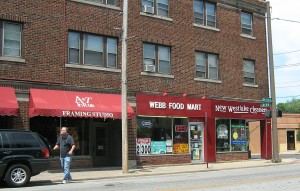
Is this art? The Webb building, Detroit Avenue at Webb Road.
Take the Webb building. It has a mother hen, concerned manager; Lebanese mini-mart guy on the ground floor; Korean dry cleaner; small-town Ohio Suzuki violin teacher upstairs; a Continental Express flight attendant, a truck driver, a welder, etc.
Some of these Webb tenants marry each other. (That’s bad for business. They move in together and I have an empty.)
—-
2 of 2 posts for 8/5/09.
August 5, 2009 No Comments
PIANO MEN
Highly sensitive people. That’s a book title: The Highly Sensitive Person. These folks are bugged by eyeglasses that rub their temples; pillows that don’t fluff out enough; shoes that don’t breathe well. Basically, they’re like Woody Allen but not as funny or famous.
Cleveland has its share. These highly sensitive people shouldn’t live in apartment buildings.
When I lived in an apartment, I thought the guy upstairs was dropping weights all day. It was probably Kleenex. I bailed in three weeks.
In my real estate leases, I put an addendum: “If you’re a party animal, party elsewhere.”
Doesn’t work.
For example, I have a couple piano-playing renters. Lou, he plays classical all day. That’s OK. But then there’s Ragtime — not so well-loved. Ragtime’s neighbor periodically calls the cops and writes me letters about “headache-inducing, thundering piano music.”
I told Ragtime to go electric — get some headphones and play for himself. And I told the highly sensitive neighbor, he could move out and I’d give him his security deposit back.
He didn’t move. He just kept writing. He could crank it: “Right now I’m hearing piano music at decibel levels designed to throw the planet out of orbit . . . No more piano music!”
He liked to write more than he liked packing.
—-
1 of 2 posts for 7/29/09. Please see post below too.
—-
Yiddishe Cup concert: Wade Oval, University Circle, Cleveland.
6 p.m. Wed., April 5
—-
Watch a new YouTube video of Yiddishe Cup playing the blue klez classic “Joe and Paul.”
—-
Read a review of the CD Klezmer Guy, Pittsburgh Jewish Chronicle, 7/15/09, by Lee Chottiner.
July 29, 2009 3 Comments
