
SHE STOLE MY SKIRT!
The tenant — a poet — said she liked the way the sunlight glinted through her living room blinds onto the hardwood floor.
“But what really got me,” she said, “was your company’s Craigslist ad about ‘a closet big enough to park a Mini Cooper in.'”
I liked her. She liked my copy writing. She thanked me for “two wonderful years.”

Another tenant — a waitress — interrupted the landlord-poet lovefest. The waitress, standing at the poet’s door, said another tenant — a third person — had just stolen the waitress’ skirt from the laundry room dryer and was wearing it.
“Wearing it in the building?” I said.
“Yes.”
The skirt was a full-length, tie-dyed orange, green and red hippie shmate. The skirt’s owner — the waitress — was 26.
The thief was a middle-aged black woman who wouldn’t answer her door. Not even when the cops showed up.
Meanwhile, I was also dealing with a drunk who had run her faucet all night, on purpose, and had called my manager a “pig.”
That woman got an eviction notice right then.
I decided to phone the black woman about the tie-dyed skirt. I got her boyfriend. Good. He was on the lease; she wasn’t. I told him the skirt thief had to be out in three days.
“Don’t put me out! She’ll go,” he said. He was a solid tenant, other than he left cigarette butts all over. He was 69 and “country” — from Tennessee. On his rent checks he wrote rant instead of rent in the memo line. (Another poet?)
“She can’t stay more than three days,” I said.
“Can I ask, sir, why is that?'”
“I rented to you, not her. The woman is not on the lease.”
I didn’t bring up the stolen skirt matter; that would have complicated things. But I wanted to say: “The next time your lady friend steals clothes from the laundry room, tell her not to wear the skirt in the building!” Out in three days.
My poet tenant enclosed a poem with her final rent payment. It began:
The way the forecast told of dark clouds,
drizzle, seemed more true than the way
the sun lit hills of trees, dull golds, rusts.
[by Karen Schubert]
I read that poem about 10 times. I concluded it was a “winter is a-comin in” poem. The drunks and skirt thieves were a comin’ in for the winter.
—-
Reminder: This blog is updated twice a week: Wednesday and Friday mornings. Please see the post below too. It’s kind of fresh.
November 17, 2010 No Comments
Y TU VIOLIN TAMBIÉN
From klezmer violinist Steven Greenman‘s “lawyer”:
Postscript: Galitzianers, please note, Greenman’s class begins Thursday (Nov. 18) in Santiago de Compostela, Spain.
***
Vid-loathers, here’s pretty much the same thing as the video, in text:
Klezmer violinist Steve Greenman asked my help in translating a Spanish contract. He thought he had a gig in Spain but wasn’t sure.
The contract wasn’t in Spanish. It was in Catalan, I guessed. Terceiro for tercero, for example.
We looked at an atlas. Verdict: Steve was going to Santiago de Compostela in northwest Spain, where he would teach master violin classes. The Spaniards probably had some local language up there. [Yes. Galician/Gallego.]
I said to Steve, “I saw a movie about a guy in a wheelchair filmed there. Can’t remember the name. It’s exotic. It’s nowheresville.” [The Sea Inside, 2007.]
Steven Greenman with Yiddishe Cup, 1992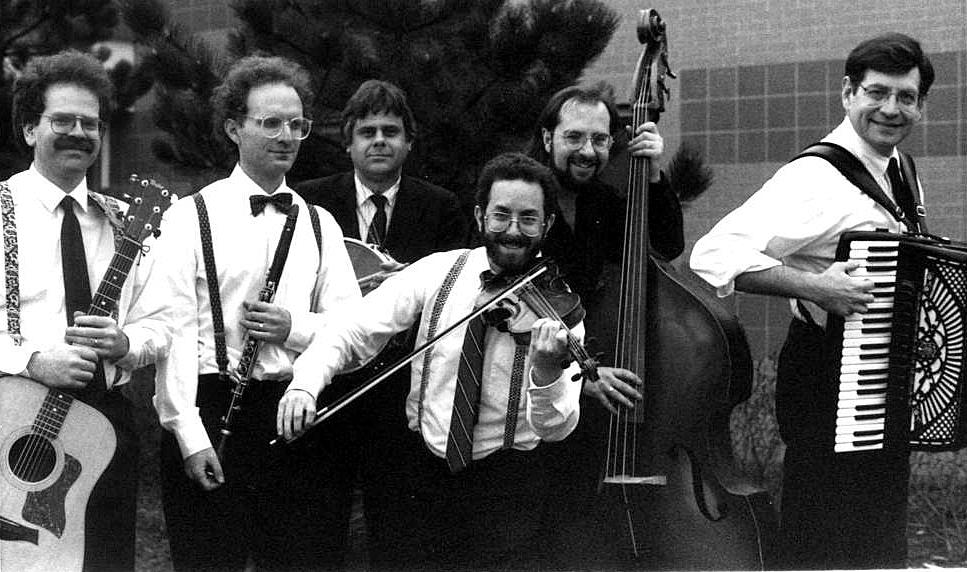
Just another day for Greenman, who expects to get gigs in faraway places. He thinks the world will come to him because he has never made a mistake on violin. A klezmer gig in northwest Spain . . .
I was glad to be a part of it, even if my role was just to say “I have no idea what this contract says.”
November 12, 2010 2 Comments
SHOULD I RENT TO A STRIPPER?
(THE MOVIE)
This is the most acclaimed animation yet from the guys over at Challah-Barbaric. This movie may appear like a navel-gazing indulgence, but it’s not. It’s magical.
Should I rent to a Stripper? is the lost collaboration between Fred Flintstone and Maimonides. It is a guide for the perplexed landlord and tenant.
The two main characters — a sleazy guy from Yiddishe Cup LLC and a bug-eyed naïf — turn the nasty, grim, cutthroat real estate world into something even grimmer — and very robotic.
The landlord is so pompous at first. Then he’s more so. But the young lady draws forth a bit of the landlord’s humanity and even a Chanukah song lyric.
After the movie, the couple goes for drinks and has an affair.
2:57 minutes. United States, 2010
—-
[The first paragraph in the capsule movie review (above) is lifted, in part, from John Ewing’s Cleveland Cinematheque calendar.]
—-
This blog is updated every Wednesday and Friday morning. Please check out the post below. It is recently hatched.
November 10, 2010 7 Comments
DOWN AND OUT IN TROY, MICHIGAN
I was down and out in a Marriott hotel in Troy, Mich. The bride, several hours earlier, had told me, “I can’t dance in these shoes. Can I just watch the hora?”
She watched. I asked her three times if she wanted to be lifted on the chair. No, she said three times. The bride and groom stood in the middle of the hora circle like statuettes on a wedding cake.
There was no place to walk at the Marriott, which was in a large shopping development.
Marriott Hotel, Troy, Mich.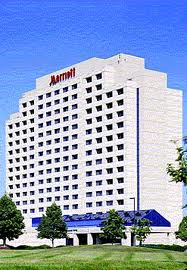
I wrote notes to myself on the hotel stationery to justify my existence. My truest observation: “Yiddishe Cup is providing a valuable service for the Jewish communities of the Midwest.”
The Marriott room had 8 pillows, 10 towels, 2 beds and 2 bathroom mirrors that showed everything.
I couldn’t justify 8 pillows, 10 towels, etc. I just couldn’t. That bride should have danced.
Luckily the hotel windows didn’t open.
—-
Yiddishe Cup plays this Sunday (Nov. 7, 4 p.m.) at the Brecksville United Church of Christ, Brecksville, Ohio. www.brecksvilleucc.org
—-
REMINDER: This blog now updates twice a week: Wednesday and Friday.
November 5, 2010 1 Comment
THE MIDWEST’S TOP 10 KLEZMER
. . . TOWNS
My nephew visits Big League baseball stadiums around the country as a hobby.
I visit Big League klezmer towns in the Midwest as a hobby. My remarks (below) are challah-to-challah comparisons. I’m not comparing Milwaukee to Paris.
The best Midwest klezmer towns:
1. Pittsburgh . . . Squirrel Hill, Shadyside. Everything you need. (Pittsburgh is not in the Midwest, but so what. It is west of the Alleghenies.)
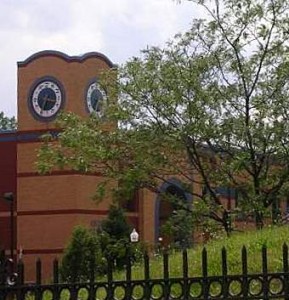
Hebrew clock. Pittsburgh JCC
2. Chicago. The Midwest klez capital. Maxwell Street Klezmer Band is the band in the Midwest. A Cleveland boy — a Northwestern student — worked in the Maxwell Street office; I had that kid wired. Yes, a klez band with office help. Chi is that big. Powerful klezmer forces prevail in Chi. Max Street does not allow Ohio bands within 80 miles of The Loop. Yiddishe Cup played Rockford, Ill., once.
3. Detroit. West Bloomfield, a Motown suburb, has Temple Israel, a very attractive modern temple. There is such a thing. At concerts, the Temple Israel ark is curtained off by a striking yarmulke mandala.
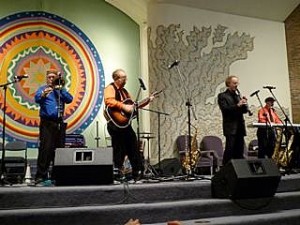
Yiddishe Cup at Temple Israel, 2010
4. Kansas City — as marvelously tough as Cleveland. KC’s Country Club Plaza is like Shaker Square but bigger and older.
5. St. Louis. Yiddishe Cup played there twice, then it all died out — the gigs. My Cleveland rabbi, who is from St. Louis, has a couple seats from the old Busch stadium. He should install the seats on our shul’s bima (altar) and invite Enos Slaughter to give the d’var torah (torah lesson/sermon). Good custard — Ted Drewes — in St. Louis. Similar to Cleveland’s East Coast Original Frozen Custard.
6. Milwaukee. Its claim to fame: songwriter Sigmund Snopek III, who wrote “Thank God This isn’t Cleveland.”
7. Minneapolis. There are a lot of klez bands up there: Prairie Heym Klezmorim, Klezmerica, etc. Too much klez in Minnie. Yiddishe Cup will never play there.
8. Cincinnati. The Plum Street Temple, where Stephen Wise officiated, is the most rakish and Moorish synagogue in the country. Check it out.

Plum Street Temple
9. Buffalo. Terrific art museum. Underrated.
10. Indianapolis. Overrated. A suburb of Atlanta.
Cleveland isn’t ranked. That wouldn’t be fair. But off the record, Cleveland is number one.
November 3, 2010 5 Comments
THE CHOCOLATE FLOWS LIKE A RIVER
At a candy-theme bar mitzvah, the dessert table is tortes and truffles, and the kids’ table is do-it-yourself ice cream sundaes and candy bars.
The bar mitzvah boy — the candy man– has a custom-printed candy bar named after him. The nutrition data reads: “Serving size — 1 young man. Ingredients — charm, wits, humor . . .”

Yiddishe Cup wants its own candy bar. It’ll be dark chocolate with slivers of old clarinet reeds. We’ll put these treats in the goodie bags for the bar mitzvah kids.
Any leftovers, we’ll take to Yiddishe Cup’s haunted house. This year our torture chamber features Don Friedman, our drummer, telling nonstop Internet musicians’ jokes like “What is the definition of an optimist? A trombonist with a beeper.”
Any leftover chocolates from the haunted house, we’ll give to our keyboard player, Alan Douglass, who is good for a candy bar and diet pop many mornings. Repeat at bedtime. I bought him a Snickers at a gas station and he refused it. It has to be MilkyWay or Three Musketeers.
***
The candy expert is Steve Almond, author of Candy Freak.
I, too, did some candy reporting, but I didn’t have the name for a career in it. In the 1980s I interviewed a chocolate factory owner who claimed dark chocolate was a Jewish thing. Maybe because of kashrut? [Jewish dietary laws]
Yes, a lot of Jews prefer dark chocolate. For one thing, it is a health food.
This year Yiddishe Cup is trick-or-treating as klezmer musicians. Yes, again. But with a twist: we’re ditching the Tevye vests and caps, and going as chocolate fountains with silver-foil Frank Gehry antlers dripping Hershey’s syrup onto our faces.
—-
1 of 2 posts for 10/27/10. Please see the post below too.
October 27, 2010 8 Comments
WHAT ANIMALS TO BRING TO A JOB INTERVIEW
Before I hire a building manager, I interview the candidate at his residence.
One man’s house had no front stoop, and he had four dogs in the living room. There was hardly any non-dog space in that house. We wound up in a bedroom on the third floor. There was a big bird up there.
How about a doormat that says “Got beer?”
I once hired a woman with that doormat and she worked out well. She was a steady worker and controlled her drinking.
Ethnic factory workers are usually solid too. Too bad they don’t exist anymore.
Ethnics or factories?
Both.
Benny Artino, a building manager, worked the day shift at Eaton Axle. His wife, Betty, was the world’s best cleaner. She wanted to be buried with a can of Comet. I gave Betty an unlimited cleaning budget. She liked to vacuum the halls every day. I didn’t try to stop her. Why would I?
When the Artinos’ son Paisan bought an apartment building in Tampa, he asked my advice, and I said: “Buy the biggest building you can afford. You might have one boiler and one roof for multi-suites, or you can have the same one boiler and one roof for a double house.”
One of my worst hires was a cocaine addict. She ran up my Home Depot account with charges for an air compressor and tool box. The gift certificate $50 was over the top. She fenced the items.
After I fired her, I went to Taco Bell to reconsider. My father had given an employee a second chance after she had ripped him off, and she had repaid my dad and stayed on the job.
But my custodian — the coke head — had told me, “I have a few shopliftings but I never stole from people.” Was I not people?
I stuck with fired. I didn’t say, “You’re fired.” I said, “If you turn in the keys this weekend, I’ll pay your moving expenses and give you four-hundred dollars, and I won’t call the cops.” Sometimes it pays to pay people to move.
***
My favorite manager, at least to listen to, was “Roy Hamilton,” circa 1978. (“Roy Hamilton” is a composite of several former building managers.*) . . .
Bert, little bitty buddy, I’ll tell you one thing I done: I had this old car, couldn’t get it to do nothing. I pushed and pulled and beat on it. Then I throwed it over a cliff by the Rapid ravine. I said, “Let’s throw over a car.” Me and my boys done it.
My old lady was against it. She was the biggest woman for churchgoing you ever seen. She thought she was better than me.
She was skinnier than a stick. Totally emancipated. And ornery. When she got money, that heifer, watch out. Man, I didn’t dig her.
She’s still here, on Madison, over a jukebox. She breaks 100 on a good night at Mahall’s [bowling alley]. She came at me with a mouth full of beer. Got all over the floor and balls.
She’s got claws. They all do. Bert, there’s a lot of good-looking heads out there just waiting to nail you to the cross.
She makes me sick. Ferocious of the liver. That’s a situation. Nobody comes between me and my beer, but that broad somehow does.
It’s all in the numbers. Course it is. I ain’t asking for much. This upcoming repression is going to be so bad it’ll shake your teeth loose. I just want to be reborn the poodle of a rich lady. That’s my next life.
Little bitty buddy, you got a number? Ain’t nothing but 1, 2, 3. Give me a number. What’s the new rent on apartment 34? $235? That’s my number. You just gave me a number!
—
* “Roy Hamilton” is mostly the real Roy Hamilton, a Tennessee-born building manager who was a painter at Midland Steel (Cleveland). He died in 1984. Note: I lifted several lines (in the first two paragraphs of this “Roy Hamilton” saga ) from Arkansas writer Charles Portis, to get in gear.
—
1 of 2 posts for 10/20/10. Please see the post below too (which was technically put up yesterday).
October 20, 2010 1 Comment
HOW HARVEY PEKAR DIED
Comic book writer Harvey Pekar died from an “accidental” overdose of anti-depressants, the Cuyahoga (Cleveland) County coroner ruled.
Powell Caesar, the coroner’s spokesman, said Pekar died from “acute intoxication via ingesting fluoxetine [Prozac] and bupropion [Wellbutrin].”
Powell continued, “The death was accidental. Ingestion was accidental. This case is closed.”
The autopsy and toxicology analyses were completed last week.
Harvey died July 12 in his bedroom in Cleveland Heights.
I contacted the coroner’s office (and talked to Powell Caesar) because I hadn’t heard, or read, how Harvey died.
October 19, 2010 3 Comments
WOLVERINE BLUES
1. RAH-RAH AND SO-SO
A simple fall pleasure is walking around Shaker Lakes listening to Michigan football on the radio.
I came by this diversion fairly recently. My older kids went to liberal arts colleges with no football teams. I figured my youngest child would too. I took him to Oberlin on a college tour and said, “Can you see yourself here?”
“In a word, Dad, no,” he said. “There’s not enough sports talk.” Jack, the youngest, wanted rah-rah.
He went to Michigan and got rah-rah. We rehashed the football games his freshman year.
I monitored the university’s Web site like a helicopter parent. I told my son to audition for the pep band, the Hillel a cappella group, the school’s percussion group and anything else he could think of. I wanted him to find a niche at the Big U.
And I wanted Michigan to win at football, because my son was so rah-rah.
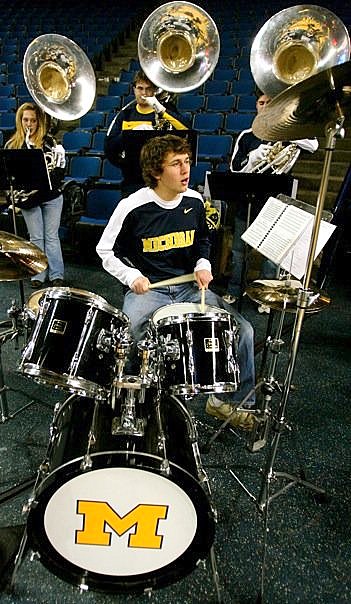
Jack Stratton, 2008. Michigan Women’s Basketball Band
I followed the football games on the Internet my son’s first year. I didn’t know about the games on Cleveland radio. That was stupefying — the Internet — like staring at a tickertape: Joe Blow . . . 3 yards . . . 3rd and 5 . . . M 46 yard line.”
Then I serendipitously found Michigan football on Cleveland radio. No more squinting at the computer. The announcer promoted Detroit pizza parlors and grocery stores. I felt like a ham operator picking up an exotic locale. “Gratiot at 8 Mile.” CKLW radio — the border blaster — was sending out the Wolverine word from Windsor.
Michigan football isn’t on CKLW this year. It’s on a weak FM station from Detroit. End of my fall bliss.
The team used to be good, then suddenly stunk. The university hired a new coach.
I asked my son what he thought of the new guy.
He said, “Who is it?”
He didn’t know about Rich Rod! (Rich Rodriquez, the new coach.) Jack had fallen under the sway of the football atheists at the Residential College and music school.
I knew more Michigan football than my son. I was now rah-rah and he was so-so. Odd.
***
2. SONNY, LISTEN
A PhD classical music student at the co-op house in Ann Arbor didn’t like my practicing. He didn’t like jazz, period. And he didn’t like my girlfriend. He called her a “hole,” which was black slang around 1970. This guy, though, was a tall blond Texan.
Tex would answer the house phone and announce to one and all: “Bertie, your hole is on the line.” (“Bertie” wasn’t too cool either.)
I punched him. He was seated on the couch in the co-op living room. I hit him and his coffee went flying. He stopped bugging people — at least me — after that. He thought I was nuts.
I wasn’t nuts. I haven’t attacked anybody since, except a teenager I punched when I taught at an ESL school. (Different story.)
In 1970 Miles Davis had just released Bitches Brew, the first big-time jazz-rock album. I borrowed recordings of Hank Crawford, Lou Donaldson and Rufus Harley from black students. I went to Baker’s Keyboard Lounge in Detroit to see Gene Ammons, Sonny Stitt and Roland Kirk.
Tex became an administrator in the Michigan music school. Mazel tov. He stayed there forever.
My youngest kid went to music school at Michigan. Mazel tov. I occasionally went to see my son perform and kept an eye out for Tex. I didn’t run into him. I was ready to apologize, unless he called me Bertie again.
Bertie? That numbskull, I swear . . .
October 13, 2010 6 Comments
THE KLEZMER RANKINGS
The Irish rank musicians with fiddle contests. So do bluegrass players. There is now even a $50,000 Steve Martin Prize for Excellence in Banjo and Bluegrass.
Jews established rankings at the Safed (Israel) Klezmer Festival, then stopped for some reason. Former Klezmatics violinist Alicia Svigals won first prize. This was more than a decade ago.
Nowadays the Jewish plucking order is out of order. Is one’s Jewish music ranking determined by where one sits at klezmer conventions? If you eat with the students, does that mean you’re amhoretz? (commoner/person of the earth). If you sit with the German long-hairs, are you going on tour in Europe soon? If you’re dining with the dentists, doctors and conference board members, do you have ulterior — biz! — motives?
At KlezKanada, one staff instructor kvetched she wasn’t paid enough for the walk-by consultations from the amhoretz in the dining hall — students asking for musical pointers and xeroxes of transcribed music.
I knew about that — pestering the staff. I bothered virtuoso clarinetist and teacher Kurt Bjorling at KlezKamp on Christmas morning. He was assembling a model train on his hotel room floor. I asked about krechts (klezmer groan/sob) technique. I wanted to be the klezmer king. The Christian king’s birthday could wait a few minutes.
***
I am a klezmer king now. (One of a few. I make the rankings.)
Here are the latest King of Klezmer rankings from The Challah Fame, Cleveland. The ratings change daily, except Saturday.
#1. Martin van de Ven. Clarinet. Canada. Van Da Man.
#2. Alan Douglass. Keyboards. Ohio. His smash hit was “Gentile on My Mind”, 2004. [Listen.]
#3. Ari Davidow. Klez cyberczar. Massachusetts. Operates the KlezmerShack in the basement of the Brandeis student union by the Foosball tables.
#4. Steven Greenman. Violin. Ohio. Born Steven Chemlawn.
#5. Annette Ezekiel Kogan. Accordion. New York. Her name is longer than her skirt. She donates letters from her skirt while playing.
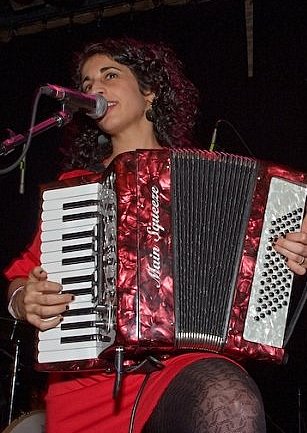
#6. Michael Alpert. Violin/mustache. New York.
#7. Gary Gould. Clarinet. California. Bandleader to the stars’ sons’ bar mitzvah parties near, but not in, Santa Monica.
#8. Cookie Segelstein. Violin. California. Rugelach Queen.
#9. Christian Dawid. Clarinet. Germany. In the States, Christian says, “Call me Dave.”
#10. Cookie Lavagetto. Third base. Washington Senators.
#11. Bert Stratton. Clarinet. Ohio. Klez merch mogul. Worldwide distributer of Yiddishe Cup mugs, baseball caps and T-shirts.
#12. Margot Leverett. Clarinet picker. New York. Former Miss Jewish Indiana.
#13. Lori Cahan-Simon. Vocals. Ohio. Produced Der Yiddisher Soul Train, KYW-TV, Philadelphia, 1967-1971.
#14. Marc Adler. Clarinet. Rhode Island. Invented the clarinet suck vac, available only at Adler’s Hardware, Providence, R.I.
#15. Yale Strom. Violin. California. Born University of Pennsylvania Strom.
—-
1 of 2 posts for 10/6/10. Please see the post below too.
October 6, 2010 4 Comments
“I DO NOT LIKE RICH PEOPLE”
A Yiddishe Cup musician, loading in at a country club, said, “I do not like rich people.”
You talkin’ to me?
What’s the median household income in the United States — $50,000?
I had access to Alan Dershowitz’s cell phone number. He did the Electric Slide at a bar mitzvah party. (I wasn’t playing; I was a guest.) I could have posted Dershy’s dorky disco on YouTube, but why embarrass a landsman – and maybe get sued. [“Landsman” means paisan.]
Dershowitz has a place on the Vineyard, I learned. Dershy is rich. “Rich” is pronounced “well-off.”
Maybe my band mate, at the country club, was upset because the club’s manager, Kim, wouldn’t let us in the buffet line, and had told us to drink only lemonade, not even pop. And we couldn’t go into the kids’ buffet line, even with all the fried junk there. [Kim is not her real name.]
We got cold-cut sandwiches around 2:30 p.m. This, for lunch?
I’ll eat anything. The video guy wouldn’t. (Later, he would.) He said, “It is truly a disgrace to serve this to professionals.” He said that to the musicians, not the manager.
I do not like rich people . . .
Photographer Herb Ascherman got a decent meal. No wraps for Herb. In his contracts, Herb has the line “client will provide a hot meal.” Herb knows how to deal with rich people and Kim, who is rich, but not well off.
—-
2 of 2 posts for 10/6/10
October 6, 2010 1 Comment
TRAVELING VIOLATIONS
1. JERUSALEM
Yiddishe Cup’s dance leader, Daniel Ducoff, flies frequently for his day job as university fundraiser. He knows which security lines are fastest. Even if he’s flying Continental, he’ll often switch to the quicker Southwest line at Cleveland airport.
Man against the machine . . .
My Uncle Al griped about tour bus drivers in Israel who turned the air conditioning too high.
My parents had travel stories about drunken Russians on cruise ships. And I heard about haggling for a gold wine bottle in Italy. I saw the slides.
I threw out the slides. I have one left: my parents at The Wall in Jerusalem. My dad had on Jack Purcells. He was always in a hurry.
Julia and Toby Stratton, 1971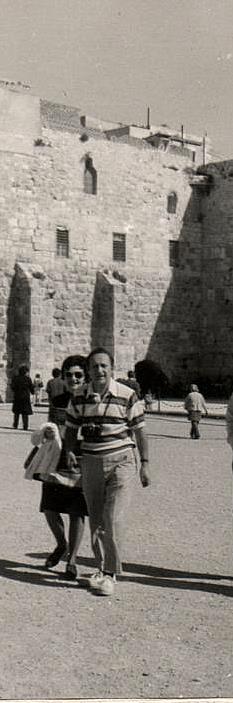
My dad kept a list of his purchases abroad. Here it is, abbreviated:
Rosewood carving of temple dog. Bangkok
Ceramic bells. Israel
Porcelain-in-pewter bowl. Hong Kong
Brass circular dish. Morocco
Wool flokati rug. Athens
My parents didn’t buy all that much. No jewelry and not much clothes. My dad left me plenty, but very little clothing. I’m not complaining. I got buildings.
***
2. KENTUCKY
Daniel Ducoff — Yiddishe Cup’s Sir Dance-a-lot — collects refrigerator magnets of states Yiddishe Cup has played. Sometimes I give Daniel magnet investment advice. For instance, 10 years ago I told him to buy “Kentucky.”
It was getting on my nerves — not playing Kentucky. Kentucky is ridiculously, abuttingly close, to Ohio.
The conductor of the Cleveland Pops Orchestra has played in 10 foreign countries and 29 states. Who’s counting.
Next month Yiddishe Cup plays Connecticut — a state which isn’t even on our screen. Is Connecticut a legitimate state? Does it have a state bird? Connecticut seems more a township or shire than a state.
Yiddishe Cup has played Ohio, Indiana, New York, Texas, Illinois, Missouri, Wisconsin, Georgia, Virginia, North Carolina, West Virginia, Michigan, Pennsylvania, Kansas, Iowa, Nebraska, Florida, Canada and, shortly, Connecticut.
Connecticut but no Kentucky. Why?
Yiddishe Cup plays in Lakeville, Conn., on 10/10/10 for a wedding. Klezmer bandleaders from the Northeast will not be happy to read this.
Or maybe they won’t care. Maybe they’ll all be in Kentucky that day.
***
3. NORTH CAROLINA HAIKU
The Greensboro Furniture Mart
convention
is happening.
No beds except at the seedy hotel
across from the Executive Club
which in Cleveland is a catering hall
but in NC is a strip joint
Are we in Amsterdam?
Continental breakfast
The Corn Flakes in the Styrofoam bowl
need milk
for weight
fast
Too late
Where’s the broom?
Musicians with instruments
at the Delta counter
“Our gig was colder than an MF,” their drummer says
“You played outside?” our singer says
The Neville Brothers’ drummer
Even the big boys freeze their pupiks.
—-
1 of 2 posts for 9/29/10. Please see the post below too.
September 29, 2010 4 Comments
BEST CROSSTOWN COMMUTE EVER
Stan Ebin, a Dixieland trumpeter and radio DJ, played these tunes on WKHR-FM:
1. “Hora Staccato.” Rafael Mendez, trumpet. Didn’t Dave Tarras record this same tune? [Yes.] (Listener’s GPS location: I-90 at Lakewood/McKinley Ave.)
2. “Blues in C# Minor.” Roy Eldridge, trumpet. (I-90 at West 117th Street by White Castle.)
3. “Lena from Palestina.” Buffalo Ridge Jazz Band from Cincinnati. This tune, like “Hora Staccato,” is part of the klezmer repertoire. (There are three “C” Innerbelt exits in a row: Central, Carnegie and Chester avenues.)
4. “Bless this House.” Four-part barbershop harmony, all on trumpet, overdubs by Roger Blackburn. (Carnegie Avenue at East 55th Street, by the old Warner & Swasey factory, where machinists made machine tools with machine tools.)
5.”Basin Street Blues.” Louis Prima, trumpet and vocals; Pee Wee Russell, clarinet. (Carnegie Avenue by the Cleveland Clinic banner “One of America’s Top 4 Hospitals.” What are the other three? Mayo Clinic, New York-Presbyterian and Johns Hopkins? No. Add Mass General, delete New York-Presbyterian.)
6. “I Can’t Get Started.” Dizzy Gillespie, trumpet. Ebin, the DJ, says, “Dizzy is stealing from Bunny Berigan.” (Stokes Boulevard by the Baldwin Water Works Plant.)
7. “Wah-Hoo.” Hoosier Hot Shots. Spike Jones before there was Spike Jones. 1935. [At the former Cleveland Heights pothole (now repaved) vortex: North Park at North Woodland.]
Two klezmer tunes, plus interesting old jazz, in a 30-minute drive from the West Side. On regular radio. Amazing.
—-
2 of 2 posts for 9/29/10.
—-
Yiddishe Cup plays tonight (Wed. Sept. 29) 7 p.m., Fairmount Temple, and tomorrow (Thurs. Sept. 30) 7:15 p.m., Park Synagogue, for Simchat Torah. Cleveland.
September 29, 2010 2 Comments
LOCATION, LOCATION, LOCA. . .
1. PITTSBURGH
Pittsburgh is where terrific walk-on musicians play with Yiddishe Cup. We had a Duquesne University guitar teacher, Kenny Karsh, sit in at wedding. How many jazz musicians know “Yossel, Yossel” and “Chusen Kale Mazel Tov”? He did.
At another Pittsburgh gig, the bride’s uncle sang. He requested the key of Ab. Nobody but a pro asks for Ab. He sang “Unchained Melody,” a slow song, even though the bride had emailed “NO SLOW SONGS.” But what could she do, the singer was her uncle. He was a hit. (Brides don’t know what they want.) He was in a Chicago society band.
Pittsburgh’s JCC has an outdoor clock with Hebrew letters on it. Pittsburghers rebuilt their JCC in Squirrel Hill, where it had previously been. In Cleveland, no Jewish institution would rebuild in the same place. Twenty-five years and out. That’s the rule in Cleveland. Move it.
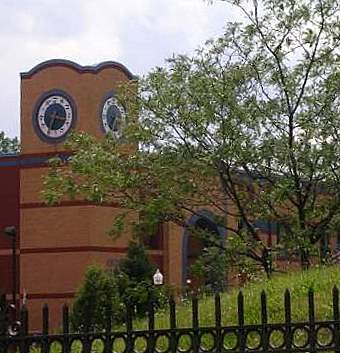
Pittsburgh JCC
When the Cleveland Heights JCC moved to Beachwood in 1985, my dad, Toby, bought a plaque for the new cloakroom. The plaque, which was no bigger than a business envelope, cost several thousand dollars.
Nobody noticed the plaque.
Several years later, the Beachwood JCC expanded, and Toby’s cloakroom was in the heart of the action, right next to the new auditorium.
My dad could always pick property.
Except in New Mexico. That was out of Toby’s wheelhouse. Toby foundered whenever he left Ohio. He bought a piece of land near Albuquerque that went nowhere.
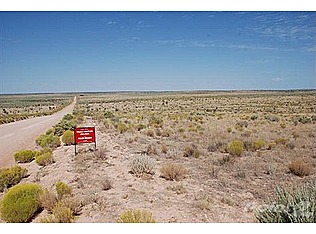
Lot for sale. Rio Rancho, New Mexico
He also did a deal on a shopping strip center in Sunrise, Fla., and lost money because he wouldn’t — or didn’t know how to — play ball with the crooked city administrators.
A relative, Lefty, sold my father the New Mexico land in 1965. Lefty was a Jew with a tattoo. Lefty lost a lot of money for a lot of people.
Toby didn’t hold the deal against Lefty. The land is still there. It’s not going anywhere.
I saw Lefty at gigs over the years. He didn’t go by Lefty any more. He got into basement waterproofing business and made a lot of money.
Forget the Land of Enchantment . . .
Pittsburgh. Pittsburgh is Yiddishe Cup’s San Francisco — hilly, terrific neighborhoods, great museums and a lot of culture. “I Left My Heart in Pittsburgh.” Write it.
***
2. BOLLYWOOD
Something important happens at weddings, unlike at bar mitzvah parties, where you’re just attending a family reunion. Pass the family reunion T-shirts.
The ultimate low-stress gig: a 50th wedding anniversary party. Play whatever you want. Everybody is glad to be there, period.
For weddings, the bandleader sometimes gets mounds of emails and communiqués beforehand. The bride doesn’t want the band to play anything slow, nothing from Broadway, and she wants to hear her Bollywood MP3s at break. Also, don’t announce the newlyweds’ names, but if you must, say “Jen and Zach.”
“I’m NOT taking his last name!!” the bride emails.
Not every bride is hands-on, though. Some say, “We know Yiddishe Cup has done this many, many times. You know what works. We trust you.” These are the best brides.
Here’s what works: skipping the Bollywood music, strolling table-to-table, varying the musical styles and inviting guests to sit in with the band. Toasts work too — in chunks. No more than three toasts in a row.
And having the wedding in Pittsburgh. Preferably at the downtown Westin. The staff there feeds Yiddishe Cup before the guests. Maybe because we’re important out-of-town musicians.
—-
Yiddishe Cup plays 7 p.m. Wed., Sept 29, Fairmount Temple, and 7:15 p.m. Thurs, Sept. 30, Park Synagogue, for Simchat Torah. Cleveland.
September 15, 2010 5 Comments
EXTREMELY EARLY HOLIDAYS
I sometimes celebrate the High Holidays a week or two before the real ones. I have the shul almost to myself. The upside: no annoying people.
However, this plan defeats one of the purposes of the High Holidays– hanging out with large numbers of Yidn. My rabbi says if you attend the real High Holidays– and shul in general– you’ll feel less lonely.
I sometimes get agitated on Rosh Hashanah morning because there is so much commotion and noise in the shul. Then the rabbi sermonizes about loneliness and community, saying, “Hell is other people according to Sartre, but what’s the alternative– sitting at home in your underwear watching reruns?” Point taken.
In the sanctuary, I see a doc who gave me a colonoscopy. I see, several rows over, a PhD scientist who is so anti-religious his seat needs an ejection button; his wife forced him to come. The guy next to me, a real estate broker, says, “How’s occupancies?”
“Commercial, bad. Residential, OK,” I say. I don’t mind some biz talk on yuntif. No big deal.
I see a weight-loss doc in the loges (the elevated seating around the perimeter of the sanctuary). Her picture is occasionally in the Cleveland Plain Dealer next to the word “obesity.” She’s in excellent shape.
A Jew visiting from New York gives me greetings from a New Rochelle cousin. Nice.
A couple people say hi to me because of the band. I don’t know their names.
After services, a worshipper asks if I remember him. Yes, I know him. A few years ago Yiddishe Cup played his son’s bar mitzvah. He is happy I remember him.
“You have to come over for shabbes,” he says. “And you won’t have to bring your clarinet.”
Sweet.
Happy New Year.
—-
1 of 2 posts for 9/8/10. Please see the post below too.
September 8, 2010 1 Comment
PORTRAITS
Two-thirds of the art in my house is by Irwin Weinberger, Yiddishe Cup’s singer. Irwin is also a painter and middle-school art teacher.
He did a portrait of my kids 19 years ago. I thought the kids — those pipsqueaks — were cute. But their pipsqueak phase dragged on for years; I would stare at that painting and say, “Grow up already!” Schlepping kids crosstown to gymnastics meets was not fun. Schlepping the youngest child to an 8 a.m. hockey game in Parma Heights was not fun. Sitting through my daughter’s swim meets was not entirely pleasant. (The diving part was pleasant, but the swimming races — which she had nothing to do with — weren’t fun.)

As it turned out, the whole thing — childrearing — lasted about two weeks.
Yiddishe Cup has been in existence 21 years, and that, too, has felt like two weeks. One day — back in 1989 — we were playing a Cleveland Heights street fair, and the next day– 21 years later– we were playing a Cleveland Heights street fair.* What’s with that?
We — the Yiddishe Cup musicians — enjoy the short drive to work. We are in our own backyard, kind of like the working musicians in Las Vegas or Branson, Mo. The downside to playing Cleveland a lot is everybody has heard us a million times.
Make it new. Or go nuts.
The newest Yiddishe Cup recruit, our drummer, has been with us 12 years. We have new music, but not new guys.
I rarely put the musicians’ names front and center. It’s all about Team Yiddishe Cup. What if a Yiddishe Cup “star” leaves? That would mess up the band’s publicity.
The band’s PR photos are like my family portrait. Same guys, basically. Why change the photos? We look the same as we did in the 1990s. I think so. It’s the same guys.
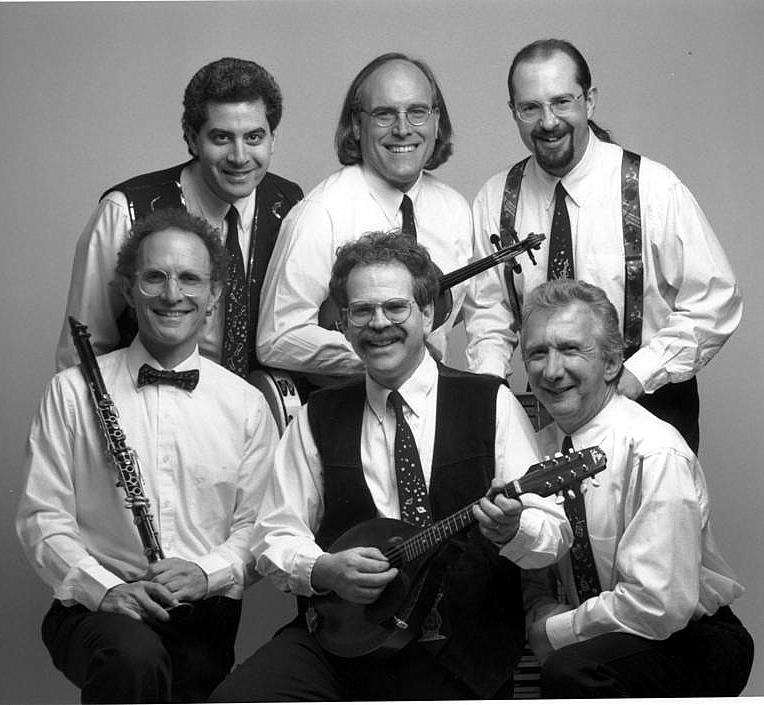
Yiddishe Cup, 1998. An outtake. The arrow in Irwin's head messed up this shot. (Photo by Charles J. Mintz)
—
* Footnote: Yiddishe Cup did not play a Cleveland Heights street fair in 2010. However, the band did play Parade the Circle in University Circle — close to, but not in, Cleveland Heights. And last year the band played for the outdoor movie/concert night at Coventry (Cleveland Heights).
—-
2 of 2 posts for 9/8/10.
L’shana tovah. (Happy New Year.)
Yiddishe Cup is at Fairmount Temple Wed. Sept 29 and Park Synagogue Thurs. Sept. 30 for Simchat Torah. Cleveland.
September 8, 2010 4 Comments
“I’LL MISS THE BLISS”
When the Kleveland Klezmorim disbanded in 1990, bandleader Greg Selker said, “I’ll miss the bliss but not the arguing with bookers and musicians.”
He became an executive headhunter.
“I’ll Miss the Bliss.” Somebody should write that tune.
My musical bliss happens most often when I hear a new instrument with Yiddishe Cup — like when Steve Ostrow first played trombone with us; or Walt Mahovlich added accordion; or Gerald Ross, Hawaiian guitar; or Shawn Fink sang “Joe and Paul.”
Or when I had Donato’s pizza with pineapple.
Selker didn’t like arguing with band mates. Who does? Luckily I haven’t had that many arguments. The worst was when a musician told me to get lost, or words to that effect, when I wanted him to commit to additional Yiddishe Cup rehearsals.
Professional musicians — guys who do only music — get very annoyed if they perceive the bandleader is trying to own them. (“Own” is a sideman’s word. Bandleaders say “hire.”)
Career musicians demand their independence and right to follow the dollar. The bandleader can only request first call, which means the sideman has to check with the bandleader before taking a gig with band number two. That sometimes gets tricky. For instance, when Yiddishe Cup’s first call is a nursing home and the sideman’s second call is the Ancona (Italy) Jewish festival.
Selker quit too early. He could have played Ancona and other exotic festivals; the Kleveland Klezmorim were one of the first klez revival, klez-fusion bands. Selker slept at Frank London’s New York apartment, which in klezmer terms is equal to the Lincoln bedroom. (London is a founder of the Klezmatics.)
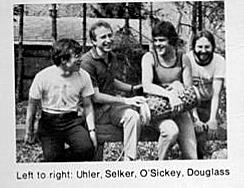
Kleveland Klezmorim, 1985
Another guest at London’s apartment was Yiddishe Cup’s keyboardist, Alan Douglass, an original member of the Kleveland Klezmorim. Alan slept at London’s when the Kleveland Klezmorim played Carnegie Hall . . . Carnegie Hall Cinema. The Kleveland Klezmorim accompanied silent Laurel and Hardy shorts in New York in 1985.
(A former Yiddishe Cup drummer played the Hollywood Bowl . . . parking lot. Yiddishe Cup played Severance Hall
. . . lobby.)
I took private lessons from Selker in 1987, which was a hassle because Selker was so footloose back then: It’s spring, Bert. I need to reschedule. I’m going for a walk in the Metroparks. I had arranged for babysitting for my kids. (Selker eventually had three boys and settled down big-time.)
Greg “I’ll Miss the Bliss” Selker . . .
At Yiddishe Cup concerts our first several years, I often thanked Selker from the bandstand. He told me to give it up. It was hard. No Selker, no Yiddishe Cup.
***
Alan Douglass sent me an email a year ago containing “cool ancient [klezmer] history,” as he called it.
Alan said the Kleveland Klezmorim drove all night from Cleveland to New York for the Carnegie Hall gig, winding up in a filthy New Jersey hotel. “Beer bottles on the window sills inside the room,” Alan said.
The band reconnoitered the next day on the steps of the Museum of Modern Art. “We played on the sidewalk,” Alan said. “Greg got a comeuppance from a local marimbist playing down the street. She was a Philharmonic percussionist and a monster — barely five feet.”
The band played three shows on Saturday and four on Sunday at the Carnegie Hall Cinema. “I don’t think I’ve ever been so tired,” Alan said. “We drove back home on Monday. I made $50.”
—-
Yiddishe Cup is in Motown this Sat. night, Sept. 4. Temple Israel, W. Bloomfield, Mich. 8:30 p.m. Free.
September 1, 2010 4 Comments
TED “SKI”
Ted Budzowski was my dad’s favorite building manager. Maybe because they were both Teds.
My dad was “Ted” at work and “Toby” at home. Ted Budzowski was “Ski” at his day job (crane operator at Republic Steel) and “Ted” around the building.
Ted Budzowski could have treated me like a silver-spoon son of a boss, but instead he invited me down to the mill on family day. I didn’t make it to the mill for some reason. Everything was air-conditioned at the mill now, Ted said, including his crane cab.
I eventually caught a tour of the mill with the Society for Industrial Archeology. The slabs of molten steel coming from the furnace looked like creamsicles. Big red melting blocks.
My dad and Ted talked in a clipped cadence, like telegrams. Ted would say, “The kid [tenant] is hanging on by the grace of God.” That meant pay up.
“That tenant is a troublemaker,” my dad answered.
“The kid better not raise a rumpus.”
“He’s thinks he’s cute.” Toby said.
“Yeah, tell it to the judge,” Ted said.
“Give him an eviction notice.”
Ted had two Stratoloungers in his living room, an Okinawan mongoose-and- cobra souvenir, and a tree-stump occasional table, which his son had made. The son lost $8,000 on tree stump tables, which never caught on big in Cleveland. The good news was the son also was a retired career solider.
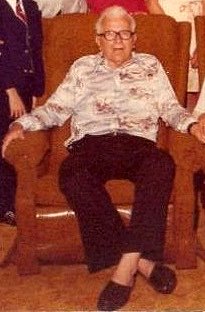
Ted Budzowski, 1978, age 63
Toby and Ted were about the same age. Toby was from Kinsman Road, and Ted had grown up in Youngstown, Ohio, near Cowshit Hill (a real place). Ted’s kids had made it out, just like Toby’s. Ted’s second son worked for the phone company.
When Ted retired to Texas to live near his military son, I hired Buck, a hard case who had grown up in a Tennessee orphanage. Buck didn’t like certain people, particularly sons of bosses. Buck thought many routine tasks — cleaning up after tradesmen, watering outdoor plants — were not part of the job.
Buck frequently got “porky” with me. (That was West Side talk for “argumentative.”) Ted, on the other hand, had always been helpful. Ted would tell me when my tire pressure was low. He could sense low tire pressure. He thought about tire pressure.
For his last 15 years, Ted’s HQ was probably his Stratolounger in San Antonio. He didn’t check back with me, except for an annual holiday card.
Meanwhile, Buck was raising prices unilaterally on odd jobs. He never asked what I thought the job was worth. Who was bossing whom?
I had a hard time bossing around people older than myself.
That changed. I got older.
—-
1 of 2 posts for 8/25/10. Please see the post below too.
August 25, 2010 4 Comments
GOOGLEGÄNGER
Bert Stratton is a pianist and singer on the Caribbean Princess cruise ship.
A man phoned and said, “Bert, this is Joe. I’m upstairs.”
I was in the basement. Joe was upstairs. Creepy.
Joe was upstairs at the other Bert Stratton’s house.
A friend of mine saw Bert perform. Bert knew me — knew of me — he told my friend.
I know Bert, sort of. The imposter always tops me on Google.
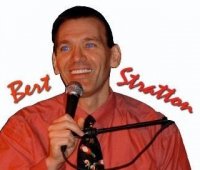
I wouldn’t mind playing a cruise ship like Bert Stratton. I know a retired rabbi — Bernard Ducoff, the father of Yiddishe Cup’s dance leader Daniel Ducoff — who does cruise ship gigs. He’s the boat rabbi for a week or so. Yiddishe Cup could do a Caribbean klezmer cruise. There already is a Caribbean cantors cruise on Kosherica lines. (Not fiction.)
I could not see doing a klezmer bus tour. No thanks to blowing clarinet on a moving vehicle. Bad for the teeth. I was asked to play on Lolly the Trolley and said no.
I could play klezmer on an elevator. I did. Yiddishe Cup played elevator music at the opening of Stone Garden Center for Adult Living. We have played at Stone Garden many times since, but not in the elevator. We call our Stone Garden gigs “playing the Garden,” as in Madison Square Garden.
Has Bert Stratton ever played the Garden?
—-
2 of 2 posts for 8/25/10
August 25, 2010 2 Comments
WILY WEATHER
1. A HARD RAIN’S A-GONNA MAYBE FALL
Yiddishe Cup’s keyboard player doesn’t like to play in direct sunlight. He wants our contract to say “We will not play in direct sunlight.”
I ignore him. At summer concerts, I try to set up outside. This has cost the band one loudspeaker, damaged by heavy rain.
Yiddishe Cup has played on the Wiley Middle School lawn, University Heights, Ohio, for 16 years and has moved inside the school three times. (Thus, there is a 19 percent chance we’ll get rained out in Cleveland on an August night.)
At private parties, clients sometimes rent backyard tents just so they can have something extra thing to worry about — whether the tent will blow down or not. Some Jews will pay extra for another worry.
Yiddishe Cup played a tent in Dayton, Ohio, where it rained so hard, busboys poked holes in the canopy to collect rain into garbage cans. I thought the band might get electrocuted, the floor was so damp.
At a Shaker Heights tent, the air was so hot and humid, my clarinet slid apart at the cork joints. Biloxi, Miss., had nothing on Shaker that night.
Yiddishe Cup played poolside in a Shaker backyard. We were like Catskill mambo kings. At the Akron (Ohio) JCC, we also played poolside, and the kids tried to splash us with belly slams and cannonballs. That was Family Fun Day, a.k.a. Let’s Destroy Professional Musical Instruments Day.
Yiddishe Cup’s keyboard player doesn’t like it when I vacillate between indoors and outdoors. Mr. Keyboard Player, who are you going to trust, AccuWeather or your leader?
I avoid indoors if possible. Granted, outdoor sound is mediocre, but the breeze is good and the kids get to run on the grass, and summer is so brief.
Last summer at University Heights, we moved the band’s equipment indoors at the last minute. The storm knocked down a chain-link fence and several trees. That was one of my better calls.
—-
Here’s a video clip from last year’s concert. (The stage patter at the end of the song, at 1:58 min., is amusing.)
***
2. ELI, ELI
Eli “Paperboy” Reed played at University Heights with Yiddishe Cup the night the power went out throughout Ohio, then Michigan, Ontario, and the entire Northeast. Maybe Eli caused the Northeast Blackout of August 2003. Eli, not FirstEnergy. We continued the concert with a battery-powered amp.
Eli “Paperboy” Reed doesn’t need, or probably want, a middle-aged klezmer guy saying nice things about his new album, Come and Get It. (Klezmer Old Dude = Kiss of Death.) I’ll keep it low-key. Ta-da . . .

Eli “Paperboy” Reed sings and writes original, yet classic-sounding, R&B/soul. No, “Eli ‘Paperboy’ Reed” is not a pseudonym for my son the drummer. My son-the-drummer’s pseudonym is DJ Paradiddle.
Reed, 26, is big in Europe. Like on The Ed Sullivan Show (the modern-day Brit equivalent) and the cover of Rolling Stone (the Brit equivalent). Look for Come and Get It on Capitol Records and for Eli everywhere. He was on NPR “Weekend Edition” [hear] several days ago. He’ll probably be on late-night American TV soon.
I know a couple klezmer guys who are big, too, who played with Yiddishe Cup. Years ago the bass player for the Klezmatics did a gig with us in Toledo.
Ipso facto, there is no such thing as “big” in klezmer.
Eli Reed doesn’t play klezmer, though. When he performed with Yiddishe Cup, he did soul/R&B.
Reed and his band, the True Loves, have a gutsy Stax-like sound, which provides the core support to Reed’s emotive lyrics, which are rabbit punches to the solar plexus of young love. Example: “You went from name calling to calling my name. You went from school-yard teasing to all night pleasing.” That is clear-cut sawing in the coming-of-age forest.
Eli — they love him in España and France. I hope Eli “Paperboy” Reed becomes huge in America, and says in passing, “Yiddishe Cup is all right,” and Yiddishe Cup gets more gigs.
When you buy Eli “Paperboy” Reed’s Come and Get It, tell them — Reed, Capitol, iTunes, et al. — Yiddishe Cup sent you.
—-
1 of 2 posts for 8/18/10. Please see the post below too.
—-
See Yiddishe Cup 7 p.m. tomorrow (Thurs. Aug. 19) at Wiley Middle School, 2155 Miramar Blvd., University Hts., Ohio. Free. Indoors if raining.
August 18, 2010 2 Comments
